Wheel Bolt Pattern Chart
Measure two studs to find your bolt pattern, convert a pattern between mm and inches, or identify the thread of your lug nuts.
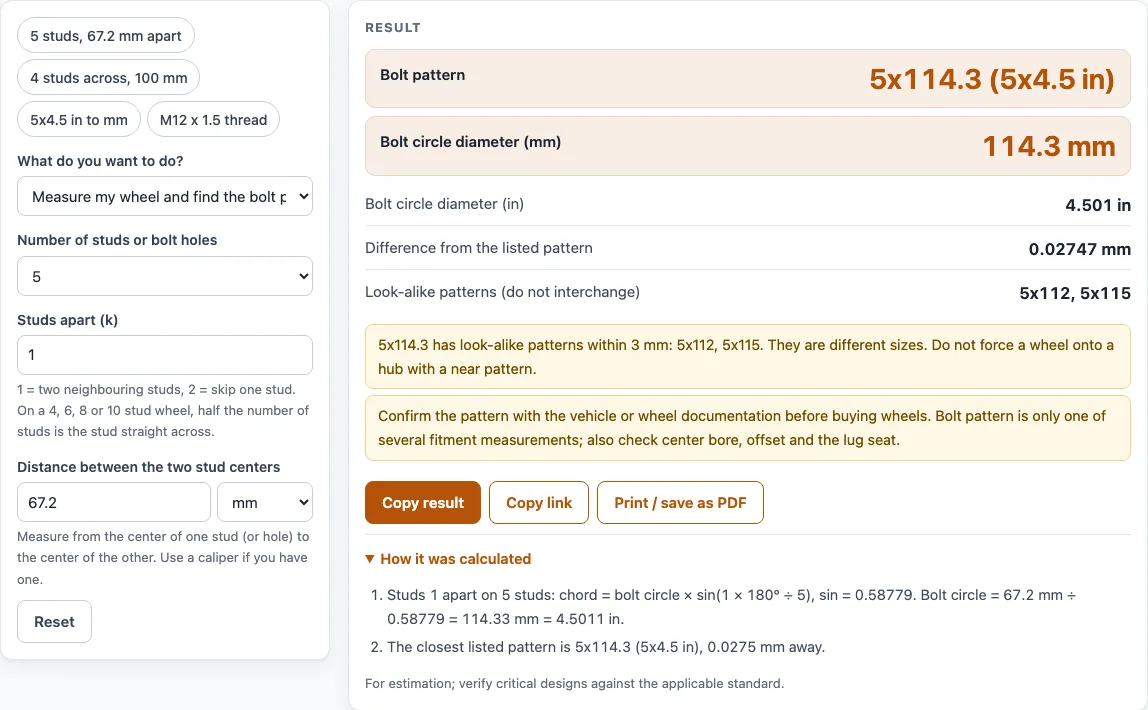
How to use the Wheel bolt pattern chart
- Under “What do you want to do?”, choose Measure my wheel and find the bolt pattern, Convert a bolt pattern between mm and inches, Identify my lug nut or stud thread, or Show the tables.
- To measure, choose the number of studs or bolt holes. Then set “Studs apart”: 1 for two neighbouring studs, 2 to skip one stud. On a 4, 6 or 8 stud wheel, half the number of studs is the stud straight across.
- Measure the distance between the centers of those two studs, enter it and choose mm or inches. A caliper gives the best accuracy.
- Read the bolt circle diameter in mm and inches, and the closest listed pattern. Any look-alike patterns are listed with a warning.
- To convert, type a pattern such as 5x4.5 or 5x114.3. A bolt circle below 20 is read as inches unless you type mm.
- To identify a thread, choose metric or inch, enter the thread’s outside diameter and the pitch (mm) or threads per inch.
- Open “How it was calculated” under the result to see the steps. Use a preset button above the form to load a typical case.
Click “Reset” to restore the starting example. Copy result, Copy link and Print / save as PDF are covered in the FAQ below.
What is a wheel bolt pattern?
A bolt pattern is written as the number of studs (or bolt holes) followed by the diameter of the circle that passes through their centers, called the bolt circle diameter (BCD) or pitch circle diameter (PCD). For example, 5x100 means five studs on a 100 mm circle, and 5x114.3 means five studs on a 114.3 mm (4.5 in) circle. Wikipedia lists 100 mm, 112 mm and 114.3 mm among the most common values and notes that more than 30 different patterns have been used by car makers.
How do I measure a wheel bolt pattern?
The studs sit evenly on a circle, so the distance between two studs is a fixed fraction of the circle diameter: distance = bolt circle × sin(k × 180° ÷ n), where n is the number of studs and k is how many studs apart the two you measure are. So bolt circle = distance ÷ sin(k × 180° ÷ n).
On an even number of studs, measure straight across between opposite stud centers. That distance is the bolt circle. On 5 studs there is no stud straight across, so measure neighbouring studs: for 67.2 mm the bolt circle is 67.2 ÷ sin 36° = 67.2 ÷ 0.5878 = 114.3 mm, a 5x114.3 pattern.
Is 5x114.3 the same as 5x4.5?
Yes. 4.5 in × 25.4 = 114.3 mm exactly. Inch names are exact conversions: 5x5 is 5x127, 5x5.5 is 5x139.7, 5x4.75 is 5x120.65 and 8x6.5 is 8x165.1. Do not confuse near sizes: 5x114.3 and 5x115 differ by only 0.7 mm, and 5x112 is 2.3 mm away, but they are different patterns and should not be forced onto a hub.
What lug nut size do I need?
The lug nut thread varies by car brand. Wikipedia lists these metric threads: M10x1.25, M12 with 1.25, 1.5 or 1.75 mm pitch, M14 with 1.25, 1.5 or 2 mm pitch and M16x1.5, and says M12x1.5 and M14x1.5 are the most common. Some older US cars use inch threads such as 7/16-20 and 1/2-20. The page identifies a thread from its measured outside diameter and pitch. The nut also needs the right seat shape: cone (normally 60 degrees), ball or flat. A nut with the wrong seat will not hold the wheel properly.
Sources
Checked October 2026: bolt patterns from the list on Wikipedia, Wheel sizing (from boltsirkel.no; the duplicate 5x120.6 removed, 8x165 written 8x165.1 as 6.5 in); lug threads and seat shapes from Wikipedia, Lug nut. The chord formula is plane geometry; inch conversion is exact at 25.4 mm.
For estimation; verify critical designs against the applicable standard.
Worked examples
| Input | Result |
|---|---|
| 5 studs, 67.2 mm between studs 1 apart | bolt circle 114.33 mm (4.501 in): 5x114.3 (5x4.5 in) |
| 4 studs, 100 mm between studs 2 apart | bolt circle 100 mm (3.937 in): 4x100 |
| pattern 5x4.5 | 5x114.3 (5x4.5 in): 114.3 mm = 4.5 in |
| pattern 5x112 | 5x112: 112 mm = 4.4094 in |
| 12 mm major diameter, 1.5 mm pitch | M12x1.5 |
| tables | 30 patterns and 10 threads |
Calculated by the tool above with these values.
Frequently asked questions
Can I use the results in commercial projects or client reports?
Yes. You can use the results in commercial work, including quotes, design notes, reports and client projects, without attribution. The result itself says it is for estimation, so verify critical designs against the applicable standard. The tool does not certify compliance with any code.
Is the calculator free, and is anything I type uploaded?
Yes, the calculator is free and needs no account or sign-up. Everything is calculated in your browser, and nothing you type is uploaded.
Can I print or share a calculation?
Yes. “Print / save as PDF” produces a one-page record with the inputs, results, calculation steps and date. “Copy link” copies the page address, which stores every input in the ?s= part of the URL, so the same calculation reopens later or can be sent to a colleague. “Copy result” copies the result lines with a link.
Does the chart tell me which wheels fit my car?
No. The tool names a bolt pattern and does not look up vehicles. Always confirm with your owner’s manual or the vehicle maker. Bolt pattern is only one fitment measurement: center bore, offset, wheel width and lug seat also matter.
How accurate is a measurement made with a ruler?
A ruler is enough to tell most patterns apart, but near sizes (5x114.3 and 5x115, or 5x112) are only 0.7 to 2.3 mm apart. Use a caliper, measure the studs as far apart as you can, and on wheels with many studs be careful because a small error in a short distance becomes a large error in the bolt circle.
Why does the tool say “no match”?
It compares your bolt circle with 30 listed patterns for the same number of studs and accepts a difference up to 0.6 mm. If nothing is that close, the measurement may be off, or the wheel uses a pattern that is not on the list. The list is not every pattern ever used.
Related tools
- Offset rim calculator: use it to convert wheel offset to backspacing and see how a new wheel sits in the arch.
- Tire size calculator: use it to turn a tire code into diameter and sidewall.
- Tire load index chart: use it to read how much load a tire can carry.
- Tire speed rating chart: use it to read the speed symbol on a tire.
- Torque converter: use it to convert units for a lug nut tightening torque.
- All power transmission calculators: use it to browse every calculator on the site.