V Belt Calculator
Choose the belt section and enter the pulley pitch diameters and centre distance to get the belt length and the nearest standard size.
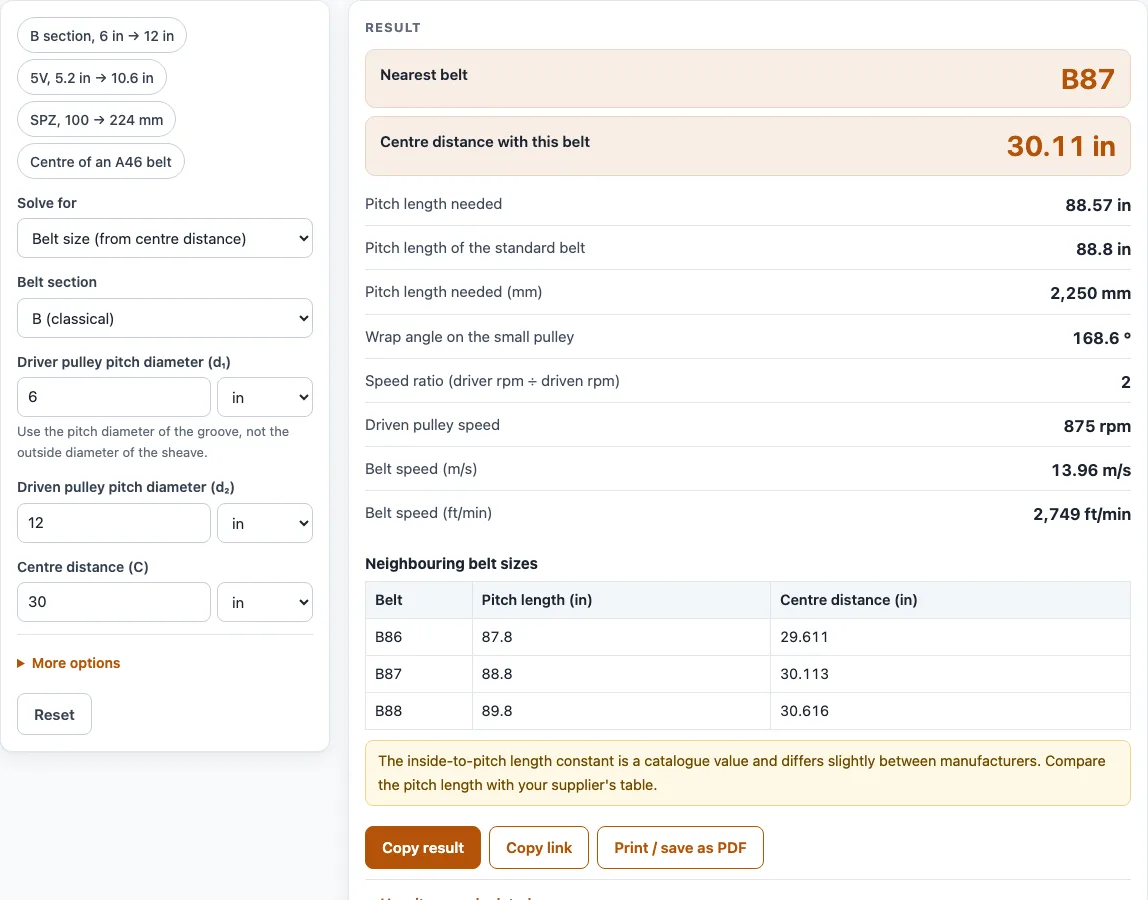
How to use the V Belt Calculator
- Under Solve for, pick Belt size to find the belt from the pulleys and centre distance, or Centre distance (from a belt number) to find where the pulleys must sit.
- Choose a belt section from the list: classical A, B, C, D or E; narrow 3V, 5V or 8V; or metric SPZ, SPA, SPB or SPC.
- Enter the driver and driven pulley pitch diameters. Use the pitch diameter of the groove, not the outside diameter. For 3V, 5V and 8V use the sheave outside diameter.
- Enter the centre distance, or the belt number if you chose the second mode.
- Optionally enter the driver rpm to see the driven speed.
- Set the unit menu beside each value. You can mix inch and mm entries because the tool converts them before it calculates.
- Read the result. It updates as you type. Check the warnings, then open “How it was calculated” to see the formula and the substituted values.
- Open “More options” only if you need to change the catalogue constant. Press “Reset” to return to the starting example, or use a preset button above the form to load a typical case.
Once the result is right, “Copy result” copies the result lines with a link. “Copy link” copies the page address, which stores your inputs, so the calculation can be reopened or sent to a colleague. “Print / save as PDF” produces a one-page record with the inputs, results, calculation steps and date.
How is the pitch length of a V belt calculated?
The pitch length is the length of belt measured along the pitch line of the grooves, and the calculator uses the standard formula Lp = 2C + π(D + d)/2 + (D − d)²/(4C). Here C is the centre distance, and D and d are the pitch diameters of the larger and smaller pulleys. Using pitch diameters, rather than outside diameters, matches the way belts are catalogued.
How does a V belt number relate to its length?
The belt number is a code for length, and the code depends on the section. For classical belts, the number is the inside length in inches, so an A46 belt has a 46 in inside length. The pitch length is the inside length plus a catalogue constant: 1.3 in for A, 1.8 in for B, 2.9 in for C, 3.3 in for D and 4.5 in for E. For narrow 3V, 5V and 8V belts, the number is the outside length in tenths of an inch, so a 5V1000 is 100.0 in. Gates’ design manual applies that outside length together with the sheave outside diameters, so the calculator uses it directly and applies no offset; you can type your own catalogue offset under More options. Metric SPZ, SPA, SPB and SPC belts are named by their datum (pitch) length in mm, so SPZ 1250 is 1250 mm.
How is the nearest standard V belt size chosen?
The calculator rounds the required pitch length to the nearest available size: a whole inch for classical belts, 0.5 in for narrow belts, and the nearest mm for metric belts. This gives a nominal designation, because stock sizes vary by supplier. If rounding changes the pitch length by more than 1 percent, the result shows a warning.
How is the centre distance found from a belt length?
When you know the belt, the calculator solves the formula for C in closed form: C = (b + √(b² − 32(D − d)²))/16, where b = 4L − 2π(D + d). It then gives the centre distance for the rounded belt, plus a table of the belts one size smaller and larger with their centre distances. Two checks apply. The centre distance should be no more than 3(D + d) and no less than D. The wrap angle on the small pulley should be at least 120 degrees. The calculator warns when either limit is not met, and also when the speed ratio is above 7:1 or the belt speed is above 30 m/s.
Worked examples
| Input | Result |
|---|---|
| B, d₁ = 6 in, d₂ = 12 in, C = 30 in | B87 (L = 88.57 in) |
| 5V, d₁ = 5.2 in, d₂ = 10.6 in, C = 36 in | 5V970 (L = 97.02 in) |
| SPZ, d₁ = 100 mm, d₂ = 224 mm, C = 450 mm | SPZ 1417 (L = 1,417 mm) |
| A, d₁ = 4 in, d₂ = 8 in, belt A46 | C = 14.08 in |
Calculated by the tool above with these values.
Frequently asked questions
Can I use the results in commercial projects or client reports?
Yes. You can use the results in commercial work, including quotes, design notes, reports and client projects, without attribution. The result is an estimate, so verify critical designs against the applicable standard. The tool does not certify compliance with any code.
Is the calculator free, and is anything I type uploaded?
The calculator is free, and there is no account or sign-up. Everything is calculated in your browser, and nothing you type is uploaded.
Can I print or share a calculation?
Yes. “Print / save as PDF” produces a one-page record with the inputs, results, calculation steps and date. “Copy link” copies a page address that stores every input, so you can reopen the same calculation later or send it to a colleague.
Why does the result give a nominal belt size instead of an exact one?
Belt numbers are standard designations, and the rounded size depends on the rounding rules for each section. Stock sizes also vary by supplier. Before ordering, confirm the belt number in the supplier’s catalogue, because the catalogue constants come from manufacturers’ conversion tables.
Can I mix inch and metric values in one calculation?
Yes. Each quantity has its own unit menu, so you can enter one pulley in inches and the other in mm. The tool converts all values before it calculates.
Related tools
- Belt Length Calculator: use it when you need the belt length for a drive without choosing a V-belt section.
- Timing Belt Calculator: use it for toothed timing belts rather than V belts.
- Gear Ratio Calculator and Gear Ratio Finder: use it to compare speed and torque across gear pairs.
- Axle Ratio Calculator: use it to work out the final drive ratio of a vehicle axle.
- Bearing Life Calculator: use it to estimate how long a bearing in the drive will last.
- Bicycle Gear Calculator: use it to check gear inches and speeds on a bicycle.
- Chain Length Calculator: use it when a drive uses roller chain instead of belts.
- All power transmission calculators: use it to browse the full set of tools on the site.
Sources
Gates Heavy Duty V-Belt Drive Design Manual (belt length, datum system, narrow-belt outside length); RMA IP-20 inside-to-pitch constants for classical belts as published by Gates; ISO 4184 datum lengths. For estimation; verify critical designs against the applicable standard.