Torque Calculator: Formula for Torque and Unit Converter
Convert torque between N·m, ft·lb and in·lb, or calculate torque from a force and lever arm, from power and speed, or for a wrench extension.
This torque calculator is a free tool that gives you the formula for torque in practice: torque equals force times lever arm times sin(theta), and the tool solves it for you. It is also a torque unit converter (Nm to ft lb, newton meter to foot pound, inch pounds to foot pounds) that handles every conversion of newton meters to foot pounds and back, works out torque from power or horsepower and speed, and corrects wrench settings for extensions and crowfoots.
Choose one of four modes, enter your values, and the result updates as you type. Each quantity has its own unit menu, so you can mix metric and US customary units in the same calculation. Every result shows the formula and your numbers.
The calculator runs entirely in your browser. There is no account or sign-up, and nothing you type is uploaded.
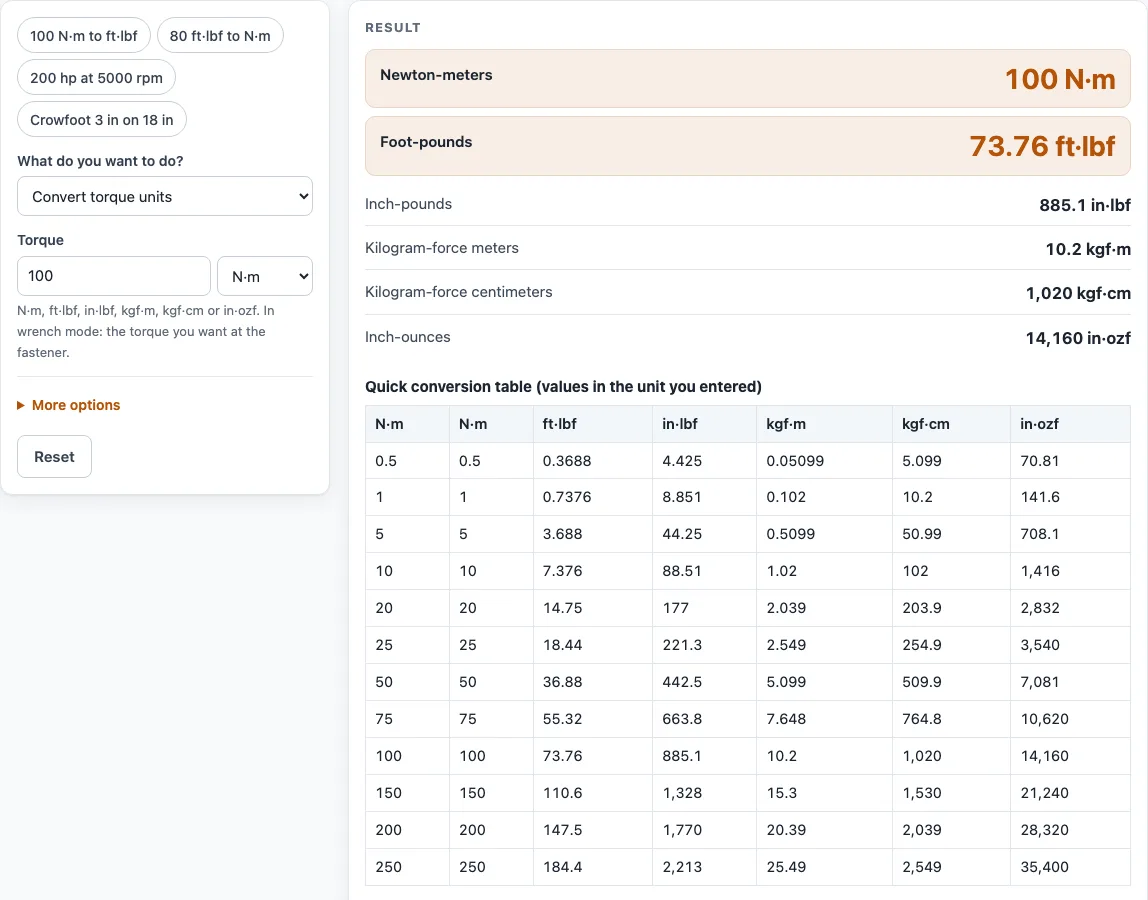
How to use the torque calculator
- Under What do you want to do?, select one of the four modes: convert torque units, torque from force and lever arm, torque with power and speed, or wrench extension / crowfoot correction.
- Enter your values in the form. Use the unit menu next to each quantity to pick the units you have, such as N·m, ft·lbf, kW, hp or rpm.
- If you need an angle, open More options. The default angle for force mode is 90 degrees.
- Read the result. It updates as you type, and any warnings appear beside it.
- Open How it was calculated under the result to check the formula, the substituted values and the answer.
- Use a preset button above the form to load a typical case, or select Reset to return to the starting example.
Select Copy result to copy the result lines with a link. Select Copy link to copy the page address, which stores all your inputs so the same calculation can reopen later or be sent to a colleague. Select Print / save as PDF to print a one-page record with the inputs, results, calculation steps and date.
For a crowfoot, enter its length from the drive centre to the fastener as E and set the angle it makes with the wrench.
What is the formula for torque?
Torque equals force times lever arm times sin(theta), where theta is the angle between the force and the arm. The sine term matters because only the part of the force that pushes at right angles to the arm turns the object. At 90 degrees, sin(theta) is 1, so torque is simply force times arm length.
For example, 150 N applied on a 0.3 m arm at 90 degrees gives 45 N·m, which is 33.19 ft·lbf. At 60 degrees the same force gives 38.97 N·m. If the force points along the arm, torque is practically zero.
How do I convert torque units like N·m to ft·lbf?
Torque units are converted with fixed factors: 1 ft·lbf = 1.355818 N·m, 1 in·lbf = 0.1129848 N·m, and 1 kgf·m = 9.80665 N·m. Divide N·m by 1.355818 to get ft·lbf. For example, 80 ft·lbf equals 108.5 N·m, and 80 ft·lbf also equals 960 in·lbf, because there are 12 in·lbf in each ft·lbf.
How do I calculate torque from power?
Power equals torque times angular speed, so torque can be found by dividing power by angular speed. In metric form, T(N·m) = 9549.3 × P(kW) / n(rpm), where 9549.3 is 60,000 divided by 2π. For example, 150 kW at 3,000 rpm gives 477.5 N·m. Working the other way, 477.5 N·m at 3,000 rpm returns 150 kW.
How do I calculate torque from horsepower?
Use T(lb·ft) = 5252.1 × hp / n(rpm). The constant 5252.1 is 33,000 divided by 2π, because one horsepower equals 33,000 ft·lbf per minute. For example, 200 hp at 5,000 rpm gives 210.1 lb·ft, which is 284.8 N·m.
How do I correct a torque wrench for an extension?
Set the wrench to T_set = T_desired × L / (L + E × cos(theta)), where L is the wrench length from the drive center to the grip point, E is the extension length, and theta is the extension angle. An in-line extension is 0 degrees, and 90 degrees means no correction is needed. For example, to put 100 ft·lbf on a fastener with an 18 in wrench and a 3 in in-line extension, set the wrench to 85.71 ft·lbf. Without the correction, the fastener would receive 116.7 ft·lbf.
Worked examples
| Input | Result |
|---|---|
| 100 N·m | 100 N·m = 73.76 ft·lbf = 885.1 in·lbf |
| 80 ft·lbf | 108.5 N·m = 80 ft·lbf = 960 in·lbf |
| 150 N at 0.3 m, 90° | 45 N·m = 33.19 ft·lbf |
| 200 hp at 5000 rpm | 284.8 N·m = 210.1 ft·lbf |
| 100 ft·lbf wanted, 18 in wrench, 3 in extension | set the wrench to 85.71 ft·lbf |
Calculated by the tool above with these values.
Frequently asked questions
Can I use the results in commercial projects or client reports?
Yes. You can use results in commercial work, including quotes, design notes, reports and client projects, without attribution.
Is the calculator free, and is anything I type uploaded?
The calculator is free. Everything is calculated in your browser, and nothing you type is uploaded.
Can I print or share a calculation?
Yes. Select Print / save as PDF to print a one-page record with the inputs, results, calculation steps and date. Select Copy link to share a link that reopens the same inputs.
Do I need an account to save my work?
No. There is no account or sign-up. Copy link stores your inputs in the page address, so you can reopen the calculation later from that link.
Can I mix metric and US customary units?
Yes. Each quantity has its own unit menu, and the tool converts all values before it calculates.
Does the torque calculator certify that a design meets a standard?
No. The tool gives estimates only. The page states: “For estimation; verify critical designs against the applicable standard.” The tool does not certify compliance with any code.
How many inch pounds are in a foot pound?
Twelve. 1 ft·lbf = 12 in·lbf, so divide inch pounds by 12 to get foot pounds, and multiply foot pounds by 1.355818 to get newton metres.
Related tools
- Gear Ratio Calculator and Gear Ratio Finder : use it when you need the ratio between gears rather than torque values.
- Axle Ratio Calculator : use it to work out the final drive ratio for an axle.
- Bearing Life Calculator : use it to estimate how long a bearing will last under a given load.
- Belt Length Calculator : use it to find the length of a belt for a pulley layout.
- Bicycle Gear Calculator : use it to compare gear combinations on a bicycle.
- Chain Length Calculator : use it to find the number of links needed for a chain drive.
- Conveyor Belt Speed Calculator : use it to work out belt speed on a conveyor.
- All power transmission calculators : use it to browse every calculator on the site.
Sources
NIST SP 811 exact unit definitions (ft·lbf, in·lbf, kgf·m); P = T·ω; torque-wrench extension from the moment balance given in torque-wrench makers’ technical notes. For estimation; verify critical designs against the applicable standard.