Tire Speed Rating Chart
Read a speed symbol or a full tire code, or enter your vehicle's top speed to find the lowest speed symbol that covers it.
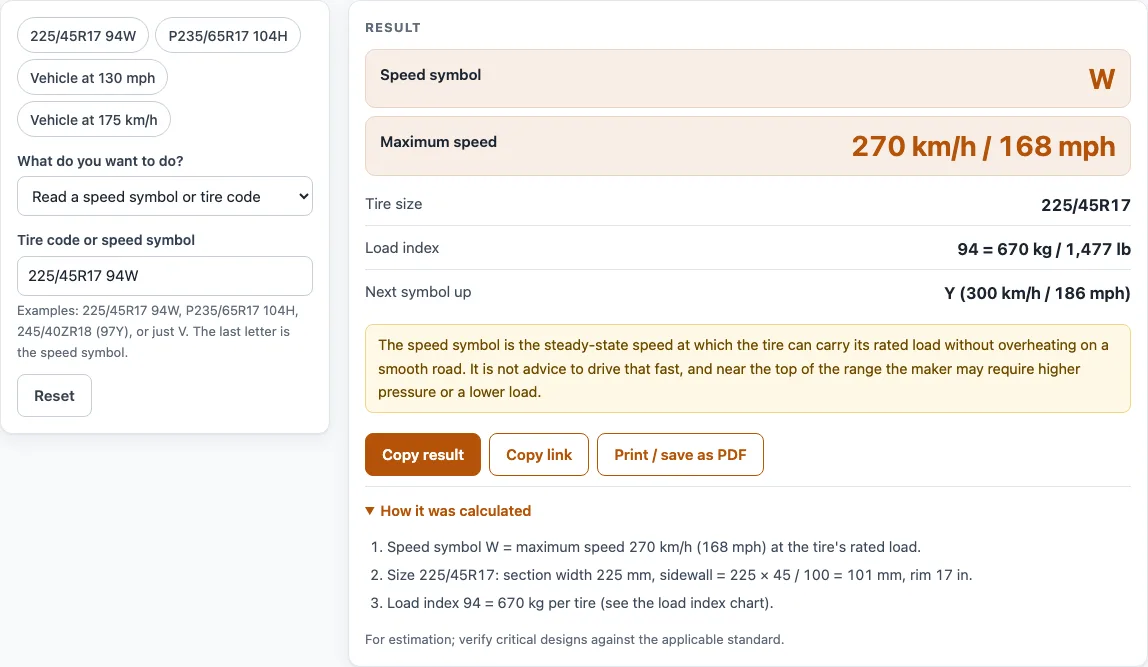
How to use the Tire speed rating chart
- Under “What do you want to do?”, choose Read a speed symbol or tire code, Find the symbol for my vehicle’s top speed, or Show the whole speed rating chart.
- To read a symbol, type the code printed on the sidewall, for example 225/45R17 94W or P235/65R17 104H. You can also type just the letter, such as V.
- Read the speed symbol and the maximum speed in km/h and mph. If your code includes a load index, the page also shows that load in kg and lb.
- To check a vehicle, enter its top speed and choose mph or km/h. The page shows the lowest symbol at or above that speed and lists every symbol that would also cover it.
- Choose the chart option to see all symbols in one table.
- Open “How it was calculated” under the result to see how the speed was read and converted.
- Use a preset button above the form to load a typical case: a 94W tire, a 104H tire, or a vehicle at 130 mph or 175 km/h.
Click “Reset” to restore the starting example. Copy result, Copy link and Print / save as PDF are covered in the FAQ below.
What does the tire speed rating mean?
The speed symbol is a single letter, or the letter A with one digit, at the end of the tire code. It is the maximum speed at which the tire can carry its rated load without overheating, measured in steady conditions on a smooth road. The ETRTO list defines each symbol: for example Q is 160 km/h (100 mph), S is 180 km/h (112 mph), T is 190 km/h (118 mph), H is 210 km/h (130 mph), V is 240 km/h (149 mph), W is 270 km/h (168 mph) and Y is 300 km/h (186 mph).
In 225/45R17 94W, 225 is the section width in mm, 45 is the aspect ratio (sidewall height as a percent of width, here 225 × 45 ÷ 100 = 101.25 mm), R means radial, 17 is the rim diameter in inches, 94 is the load index (670 kg) and W is the speed symbol.
How do I find the right speed rating for my vehicle?
Take the vehicle’s maximum speed, convert it to km/h if it is in mph (multiply by 1.609344), and pick the lowest symbol whose speed is at or above it. For example, 130 mph is 209.2 km/h, so H (210 km/h) is the lowest symbol that covers it. The page also lists the symbols above that, which are also acceptable.
Your vehicle maker’s placard or manual states the speed rating the car was designed for. In the EU a tire must be rated above the vehicle’s top speed, with limited exceptions, and other countries have their own rules, so follow the placard and local law.
What do Z, (W) and (Y) mean?
Z, (W) and (Y) have no single speed. Z means over 240 km/h (over 149 mph). A symbol in brackets, such as (W) or (Y), means the maker states its own maximum, which is over 270 km/h for (W) and over 300 km/h for (Y). Ask the tire maker for the exact limit. Before 1991 the speed letter was part of the size, before the R, for example 205/60 HR 15 (HR means 210 km/h).
Sources
Checked October 2026: speed symbols and speeds from the ETRTO list as printed on Wikipedia, Tire code (speed rating section; mph as printed there); load indexes from the same page cross-checked with Tyreteam, Load Index Chart. The EU rule is summarised on the same Wikipedia page, citing Council Directive 92/23/EEC.
For estimation; verify critical designs against the applicable standard.
Worked examples
| Input | Result |
|---|---|
| tire code 225/45R17 94W | W: 270 km/h / 168 mph |
| tire code T | T: 190 km/h / 118 mph |
| tire code 245/40ZR18 (97Y) | (Y): over 300 km/h / over 186 mph |
| vehicle top speed 130 mph | lowest symbol H (210 km/h / 130 mph) |
| vehicle top speed 175 km/h | lowest symbol S (180 km/h / 112 mph) |
| full chart | 32 speed symbols listed |
Calculated by the tool above with these values.
Frequently asked questions
Can I use the results in commercial projects or client reports?
Yes. You can use the results in commercial work, including quotes, design notes, reports and client projects, without attribution. The result itself says it is for estimation, so verify critical designs against the applicable standard. The tool does not certify compliance with any code.
Is the calculator free, and is anything I type uploaded?
Yes, the calculator is free and needs no account or sign-up. Everything is calculated in your browser, and nothing you type is uploaded.
Can I print or share a calculation?
Yes. “Print / save as PDF” produces a one-page record with the inputs, results, calculation steps and date. “Copy link” copies the page address, which stores every input in the ?s= part of the URL, so the same calculation reopens later or can be sent to a colleague. “Copy result” copies the result lines with a link.
Is the speed rating the top speed I can drive?
No. The symbol is the speed at which the tire can carry its rated load in steady, test conditions without overheating. It does not make a higher speed safe or legal. Road conditions, tire wear, pressure and load all matter, and posted speed limits still apply.
Can I fit a tire with a lower speed rating than the original?
It depends on where you live. In many places the rule is that the tire must be rated at or above the vehicle’s maximum speed, so a lower symbol may be unsuitable or not allowed. Wikipedia notes one exception in the EU: M+S tires may be rated lower if a warning sticker states the allowed maximum speed. Check the vehicle placard and local law before you choose.
Does a higher speed rating always mean a better tire?
No. The symbol only states a speed capability. A higher symbol is not wrong, but it does not say anything about grip, wear or comfort. Compare those, and the price, not only the letter.
Related tools
- Tire load index chart: use it to read the load index next to the speed symbol and find the load a tire can carry.
- Tire size calculator: use it to turn a tire code into diameter, sidewall and revolutions per mile.
- Tire size comparison: use it to compare an old and new size and see the speedometer error.
- Axle ratio calculator: use it to see how tire size and axle ratio change engine rpm at speed.
- Offset rim calculator: use it to see how a new wheel moves in and out.
- All power transmission calculators: use it to browse every calculator on the site.