Tire Load Index Chart
Look up a load index in kilograms and pounds, read a full tire code, or enter the weight to carry and get the lowest load index that is enough.
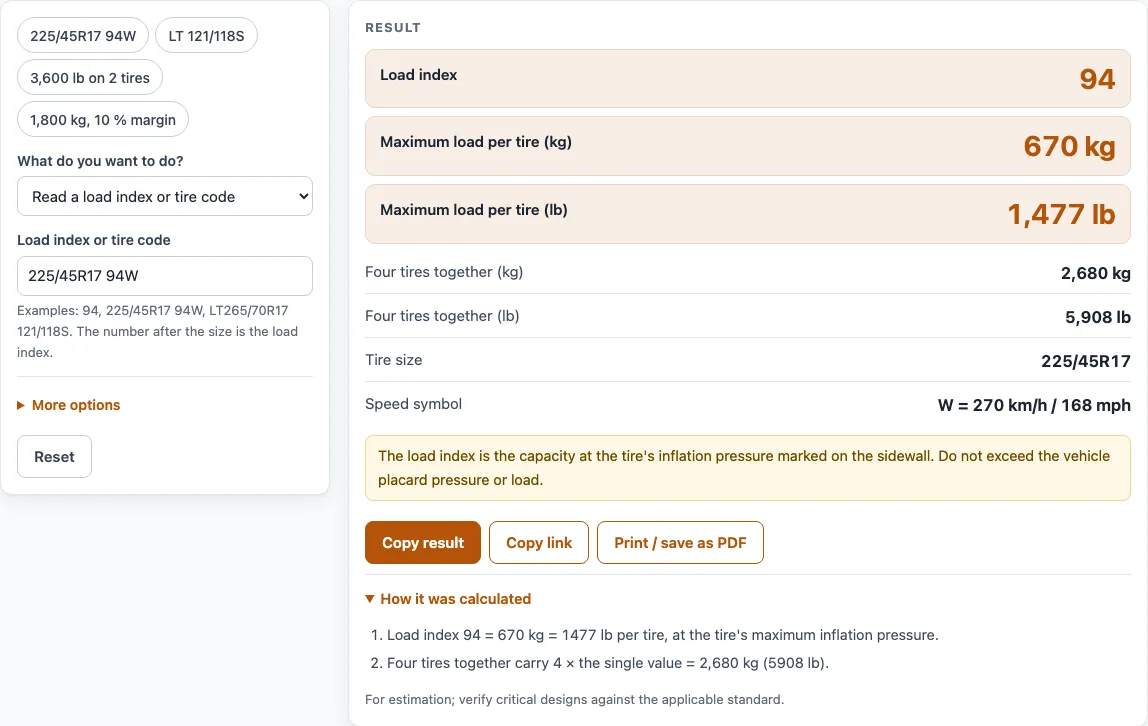
How to use the Tire load index chart
- Under “What do you want to do?”, choose Read a load index or tire code, Find the load index I need, or Show the load index chart.
- To read an index, type the number or the full code from the sidewall, for example 94, 225/45R17 94W or LT265/70R17 121/118S.
- Read the maximum load per tire in kg and lb. The page also shows four tires together, and for a two-number index the load when the tires are fitted as a dual pair.
- To find the index you need, enter the weight the tires must carry and choose lb or kg. Enter how many tires share it, for example 2 for one axle.
- Open More options to add a safety margin in percent. The page then shows the lowest load index with enough capacity, its rated load and the spare capacity.
- To see the table, choose the chart and pick cars and light trucks (60 to 126), heavy equipment (127 to 199) or all indexes.
- Open “How it was calculated” under the result to see the steps with your numbers. Use a preset button to load a typical case.
Click “Reset” to restore the starting example. Copy result, Copy link and Print / save as PDF are covered in the FAQ below.
What does the load index on a tire mean?
The load index is a two- or three-digit number after the size, for example 94 in 225/45R17 94W. It is a code for the maximum load one tire can carry at its maximum inflation pressure. Load index 94 means 670 kg (1,477 lb) per tire. The number is not the load itself: index 100 is 800 kg, 101 is 825 kg and 108 is 1,000 kg, so each step raises the capacity by a few percent.
Four tires of load index 94 can carry 4 × 670 = 2,680 kg together. The vehicle’s own load limit is set separately by its maker, so check the placard on the door jamb for the minimum load index.
How do I find the load index I need?
Divide the load by the number of tires that share it, then pick the smallest index whose rated load is at least that value. Example: an axle load of 3,600 lb on two tires is 1,800 lb, or 816.5 kg, per tire. Index 100 is 800 kg, which is too small, and index 101 is 825 kg, which is enough, so 101 is the lowest. That leaves only about 1 % spare capacity, so many people choose the next index up or add a safety margin.
When you replace tires, the load index should be at least the one the vehicle maker specifies on the placard. A lower index means the tire is carrying more than it was designed for.
What does a two-number load index like 121/118 mean?
Light truck tires may show two numbers. The first (121 = 1,450 kg) is the load as a single tire. The second (118 = 1,320 kg) is the load per tire when two tires are fitted as a dual pair on one hub. The load range letter on light-truck tires is a different marking and gives the ply rating (for example E is 10 ply).
Sources
Checked October 2026: load index table from the ETRTO/TRA list as printed on Wikipedia, Tire code (kg values; its pound column has two typing errors, so pounds here are kg × 2.20462), cross-checked against all 280 values in the Tyreteam Load Index Chart. Load range and ply: Tire and Rim Association Year Book, as listed on the same Wikipedia page.
For estimation; verify critical designs against the applicable standard.
Worked examples
| Input | Result |
|---|---|
| tire code 225/45R17 94W | load index 94 = 670 kg (1477 lb) per tire |
| tire code LT265/70R17 121/118S | load index 121 = 1,450 kg (3197 lb) per tire |
| tire code 100 | load index 100 = 800 kg (1764 lb) per tire |
| 3600 lb on 2 tire(s), margin 0 % | minimum load index 101 (825 kg per tire) |
| 1800 kg on 2 tire(s), margin 10 % | minimum load index 108 (1,000 kg per tire) |
| chart common | 67 indexes listed |
Calculated by the tool above with these values.
Frequently asked questions
Can I use the results in commercial projects or client reports?
Yes. You can use the results in commercial work, including quotes, design notes, reports and client projects, without attribution. The result itself says it is for estimation, so verify critical designs against the applicable standard. The tool does not certify compliance with any code.
Is the calculator free, and is anything I type uploaded?
Yes, the calculator is free and needs no account or sign-up. Everything is calculated in your browser, and nothing you type is uploaded.
Can I print or share a calculation?
Yes. “Print / save as PDF” produces a one-page record with the inputs, results, calculation steps and date. “Copy link” copies the page address, which stores every input in the ?s= part of the URL, so the same calculation reopens later or can be sent to a colleague. “Copy result” copies the result lines with a link.
Can I use a tire with a higher load index than the original?
Yes. A higher index means the tire can carry more, so it is not a problem for capacity. Check that the size and speed symbol still match what the vehicle maker states, and keep to the inflation pressure on the vehicle placard.
Is the load index the same as the load range or XL?
No. The load index is the number in the tire code. The load range or the letters XL (extra load) say how the tire is built, and they affect which inflation table is used. A standard-load tire may be marked with nothing, SL, or LL for light load.
Why does the chart show pounds that differ from other charts?
Pounds are calculated here as kilograms × 2.20462 and rounded. Other charts round differently, so a value can differ by 1 lb, and some printed charts contain typing errors in the pound column. The kilogram values agree between the sources we checked.
Related tools
- Tire speed rating chart: use it to read the speed symbol that follows the load index.
- Tire size calculator: use it to turn a tire code into diameter, sidewall and revolutions per mile.
- Tire size comparison: use it to compare an old and new size and see the speedometer error.
- Axle ratio calculator: use it to see how tire size and axle ratio change engine rpm at speed.
- Wheel bolt pattern chart: use it to find the bolt pattern and lug thread of a wheel.
- All power transmission calculators: use it to browse every calculator on the site.