Timing Belt Calculator
Pick the belt pitch and enter the pulley teeth and centre distance to get the belt size, or enter a belt to get its exact centre distance.
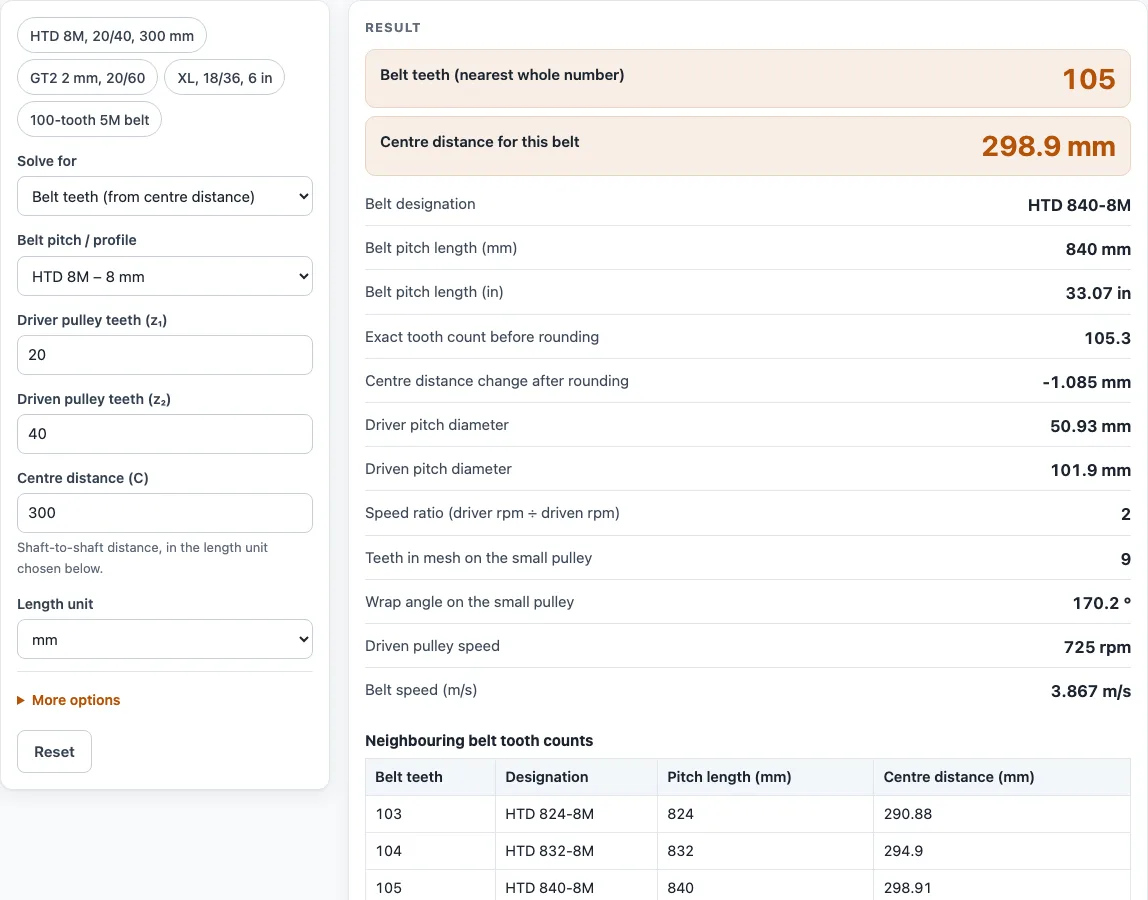
How to use the Timing Belt Calculator
- Under Belt pitch / profile, choose the belt, such as HTD 8M, GT2 2 mm, XL or H.
- Enter the driver pulley tooth count (z1) and the driven pulley tooth count (z2). Use whole numbers only.
- Under Solve for, choose belt teeth from a centre distance, or centre distance from a belt tooth count.
- Enter the centre distance or the belt tooth count for that mode.
- Set the length unit (mm, cm or inch). Each quantity has its own unit menu, so you can mix metric and US customary units.
- Optionally, enter the driver rpm to see the driven rpm and the belt speed.
- Read the result: the belt tooth count, the belt designation, the exact centre distance, the teeth in mesh on the small pulley and any warnings.
- If the rounding moves the centre distance noticeably, check the table of belts two teeth smaller and two larger.
- Open “How it was calculated” to see the formula, the values substituted and the answer with units.
Preset buttons above the form load typical cases, and Reset restores the starting example. “Copy result” copies the result lines with a link. “Copy link” copies the page address, which stores every input, so the same calculation reopens later or can be sent to a colleague. “Print / save as PDF” prints a one-page record with the inputs, results, calculation steps and date.
What is the timing belt length formula?
The belt pitch length uses the exact formula L = 2C cos(φ) + π(D + d)/2 + φ(D − d), where C is the centre distance, D and d are the pitch diameters of the two pulleys, and sin(φ) = (D − d)/(2C). The pitch diameter of each pulley is pitch × teeth ÷ π. For example, 20 teeth on an 8 mm pitch pulley give 50.93 mm.
How does the calculator find the centre distance for a whole number of belt teeth?
A belt has a whole number of teeth, so the pitch length is divided by the pitch and rounded to the nearest tooth. The exact centre distance for that rounded tooth count is found by solving the length equation numerically, and the change from your entered centre distance is shown. In the default example (HTD 8M, 20 and 40 teeth), C = 300 mm needs 842.16 mm, which is 105.27 teeth. Rounded to 105 teeth, the belt is HTD 840-8M and the exact centre distance is 298.91 mm.
How many teeth should be in mesh on the small pulley?
The teeth in mesh are floor(z_small × wrap angle ÷ 360°), where the wrap angle on the small pulley is 180° − 2 asin((D − d)/(2C)). At least 6 teeth in mesh is commonly recommended, and the calculator warns below that. The HTD 8M example above has 9 teeth in mesh on the small pulley.
How fast can a timing belt run?
The belt speed is pitch × z1 × rpm ÷ 60000 m/s, and the driven rpm is rpm × z1 ÷ z2. The calculator warns when the belt speed is above 30 m/s. In the same example, a 20-tooth driver at 1450 rpm drives a 40-tooth pulley at 725 rpm, and the belt runs at 3.867 m/s.
What do belt designations like HTD 840-8M mean?
HTD designations follow the form HTD
Worked examples
| Input | Result |
|---|---|
| HTD 8M – 8 mm, z₁ = 20, z₂ = 40, C = 300 mm | 105 teeth, HTD 840-8M, C = 298.9 mm |
| GT2 2 mm (2GT), z₁ = 20, z₂ = 60, C = 150 mm | 191 teeth, GT2 382-2GT, C = 150.5 mm |
| XL – 5.08 mm (0.200 in), z₁ = 18, z₂ = 36, C = 6 in | 87 teeth, 174XL, C = 5.972 in |
| HTD 5M – 5 mm, z₁ = 20, z₂ = 20, 100 belt teeth | C = 200 mm |
Calculated by the tool above with these values.
Frequently asked questions
Can I use the results in commercial projects or client reports?
Yes. Results may be used in commercial work, including quotes, design notes, reports and client projects, without attribution. The result is for estimation, so verify critical designs against the applicable standard. The tool does not certify compliance with any code.
Is the calculator free, and is anything I type uploaded?
Yes, the calculator is free. Everything is calculated in your browser, nothing you type is uploaded, and there is no account or sign-up.
Can I print or share a calculation?
Yes. “Print / save as PDF” produces a one-page record with the inputs, results, calculation steps and date. “Copy link” copies a page address that stores every input, so the calculation reopens with the same values. “Copy result” copies the result lines with a link.
Does the calculator give belt width, pulley diameter or belt tension?
No. It does not calculate belt widths, pulley outside diameters, or belt tension and power ratings. Check those figures with the belt supplier’s data and the applicable standard.
What should I do if the rounding moves the centre distance noticeably?
The calculator shows a warning when the rounding changes the centre distance noticeably. In that case you need an adjustable centre or an idler to take up the difference. Check the table of belts two teeth smaller and two larger to compare the options.
Related tools
- Belt Length Calculator: use it to find the length of a flat or open belt drive.
- V Belt Calculator: use it when your drive uses V belts rather than toothed belts.
- Gear Ratio Calculator and Gear Ratio Finder: use it to find the ratio between two gears.
- Axle Ratio Calculator: use it to work out the final drive ratio of an axle.
- Bearing Life Calculator: use it to estimate how long a bearing will last under load.
- Bicycle Gear Calculator: use it to compare gear combinations on a bicycle.
- Chain Length Calculator: use it to find the number of links needed for a chain drive.
- All power transmission calculators: use it to browse every calculator on the site.
Sources
Pitches per RMA IP-24 / ISO 5294 trapezoidal profiles and the HTD and GT2 trade profiles, as listed in maker catalogues (Gates, Texas Belting pitch chart); belt geometry per Shigley. For estimation; verify critical designs against the applicable standard.