Sprocket Calculator
Get the ratio, sprocket diameters and chain speed of a roller chain drive, or see how changing a motorcycle sprocket changes gearing and speed.
A sprocket calculator works out the speed ratio, output speed, chain speed and sprocket sizes for a roller chain drive. It also compares gearing changes on a motorcycle or dirt bike final drive. This calculator runs in your browser, is free, and needs no sign-up.
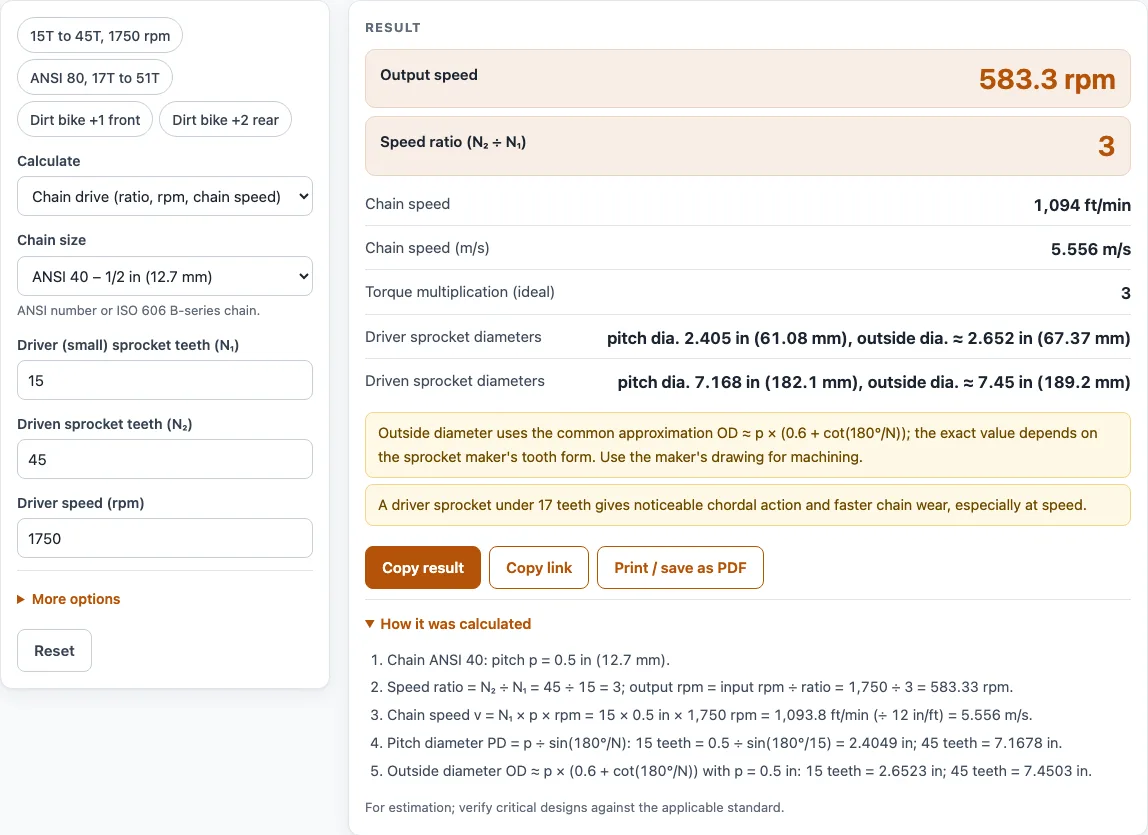
Enter the teeth and speed for your drive, and the result updates as you type. You can use ANSI or ISO chain sizes and mix metric and US customary units. The motorcycle mode shows how a change of front or rear sprocket affects top speed at a set engine rpm. Each result comes with the formula and the values used, so you can check where every number comes from.
How to use the Sprocket Calculator
- Under Calculate, choose roller chain drive or motorcycle / dirt bike final drive.
- For a chain drive, pick the chain size, such as ANSI 40 or ISO 10B. The chain size sets the pitch.
- Enter the driver teeth (N1) and the driven teeth (N2).
- Enter the driver rpm.
- For motorcycle mode, enter the stock and new front and rear teeth and the engine rpm. Open More options to set the rear wheel and tire diameter (default 26 in) and the primary x gearbox ratio (default 2.6).
- Set the unit for each quantity using its unit menu. The tool converts units before it calculates.
- Read the results, then check any warnings.
- Open How it was calculated under the result to see the formula, the values used and the answer with units.
Preset buttons above the form load typical cases, and Reset returns to the starting example. The buttons under the result copy or print the calculation. Details are in the FAQ below.
Warnings flag very small sprockets and large ratio changes. Copy result copies the result lines with a link, Copy link keeps every input in the page address, and Print / save as PDF gives a dated one-page record with the steps.
How do you calculate sprocket ratio?
The speed ratio is the driven teeth divided by the driver teeth: N2 / N1. In the default example, a 15-tooth driver turning a 45-tooth driven sprocket gives 45 / 15 = 3:1. The output speed is the input rpm divided by that ratio, so 1,750 rpm / 3 = 583.3 rpm. The ideal torque multiplication is the same ratio, 3, but this assumes no losses, so efficiency is ignored.
On a motorcycle or dirt bike, the final drive ratio is rear teeth divided by front teeth. For 13 front and 48 rear teeth, 48 / 13 = 3.692. The change is the new ratio divided by the stock ratio, minus 1. Moving to 14 front teeth gives 3.429, a change of 3.429 / 3.692 - 1 = -7.14%. A lower ratio means a higher top speed at the same rpm.
How is chain speed calculated?
Chain speed is the number of driver teeth times the chain pitch times the rpm: N1 x pitch x rpm. For ANSI chain, the leading digits of the chain number give the pitch in eighths of an inch, so ANSI 40 has a 4/8 = 1/2 in pitch, and ANSI 25 has a 2/8 = 1/4 in pitch. ISO B-series pitches are 9.525, 12.7, 15.875, 19.05 and 25.4 mm. With the pitch in inches, divide by 12 to get ft/min. With the pitch in millimetres, divide by 60,000 to get m/s.
For the default example, 15 x 0.5 in x 1,750 rpm = 13,125 in/min, which is 1,094 ft/min. In metric, 15 x 12.7 mm x 1,750 rpm / 60,000 = 5.56 m/s.
Sprocket size is shown as pitch diameter, PD = pitch / sin(180° / N). For the 15-tooth sprocket, this gives 2.405 in. The outside diameter is approximated as pitch x (0.6 + cot(180° / N)), a formula from Machinery’s Handbook. The exact value depends on the maker’s tooth form, so treat it as an estimate.
Worked examples
| Input | Result |
|---|---|
| ANSI 40, 15T driver, 45T driven, 1750 rpm in | ratio 3:1, 583.3 rpm out, chain speed 1,094 ft/min (5.56 m/s) |
| ANSI 80, 17T driver, 51T driven, 900 rpm in | ratio 3:1, 300 rpm out, chain speed 1,275 ft/min (6.48 m/s) |
| ISO 10B, 19T driver, 38T driven, 1450 rpm in | ratio 2:1, 725 rpm out, chain speed 1,435 ft/min (7.29 m/s) |
| 13/48 to 14/48 teeth (front/rear), 8000 rpm | final ratio 3.692 to 3.429 (-7.14%), top speed at that rpm 64.46 to 69.42 mph |
| 14/50 to 13/52 teeth (front/rear), 9000 rpm | final ratio 3.571 to 4 (+12%), top speed at that rpm 68.19 to 60.89 mph |
Calculated by the tool above with these values.
Frequently asked questions
Can I use the results in commercial projects or client reports?
Yes. Results may be used in commercial work, including quotes, design notes, reports and client projects, without attribution. The tool is for estimation only, so verify critical designs against the applicable standard. It does not certify compliance with any code.
Is the calculator free, and is anything I type uploaded?
Yes, the calculator is free. Everything is calculated in your browser, and nothing you type is uploaded. There is no account or sign-up.
Can I print or share a calculation?
Yes. Print / save as PDF creates a one-page record with the inputs, results, calculation steps and date. Copy link copies the page address, which stores every input in the ?s= part of the URL, so the same calculation reopens later or can be sent to a colleague. Copy result copies the result lines with a link.
Why does the outside diameter differ from my sprocket?
The outside diameter is an approximation based on the pitch and tooth count. The exact value depends on the tooth form the maker uses. Check the manufacturer’s data for final dimensions.
What do the warnings mean?
Warnings flag sprockets under 9 teeth (and a milder warning under 17) or over 150 teeth. They also flag a single-stage chain ratio above 7:1, a final drive ratio change above 15%, motorcycle ratios outside 1.5 to 6, and wheel diameters outside 8 to 40 in. Check any flagged value before you rely on the result.
What does the “same ratio” rear tooth count mean?
It shows the rear tooth count that would give your new ratio while keeping the stock front sprocket. For the default example, the answer is 44.57. Rear sprockets come in whole teeth, so you would compare the nearest available sizes.
Related tools
- Gear Ratio Calculator - use it to find the ratio of any gear pair, not only chain sprockets.
- Axle Ratio Calculator - use it to compare axle ratios and their effect on vehicle speed.
- Bearing Life Calculator - use it to estimate how long a bearing will last under a given load.
- Belt Length Calculator - use it when a belt, rather than a chain, connects your pulleys.
- Bicycle Gear Calculator - use it to check gear combinations and speeds on a bicycle.
- Chain Length Calculator - use it to find the number of links for a chain drive once the sprockets are chosen.
- Conveyor Belt Speed Calculator - use it to find the belt speed of a conveyor system.
- All power transmission calculators - use it to browse every calculator on the site.
Sources
Chain pitches per ASME B29.1 (ANSI) and ISO 606 (B series); pitch and outside diameter formulas as published in ASME B29.1-based maker catalogues (Tsubaki). For estimation; verify critical designs against the applicable standard.