Planetary Gear Ratio Calculator
Enter the sun, planet and ring teeth to get the ratio of every configuration, the speed of each member and a check that the set will assemble.
How to use the Planetary Gear Ratio Calculator
- Enter any two of Zs (sun teeth), Zp (planet teeth) and Zr (ring teeth). The third is filled in from Zr = Zs + 2 × Zp. For example, Zs 12 and Zr 48 give Zp 18.
- Enter the number of planets. The page needs at least 2, and tooth counts must be whole numbers.
- Choose the input member: sun, ring or carrier.
- Choose the held member, which stays stationary. The third member becomes the output.
- Enter the input speed in rpm.
- Read the result. It updates as you type and shows the output speed, the speeds of the sun, ring and carrier, and the planet spin. Any failed check appears as a warning beside the result.
- Open “How it was calculated” to see the formula, the values substituted and the answer with units.
- Scroll to the table of all six configurations to compare ratios and output rpm for the same tooth counts.
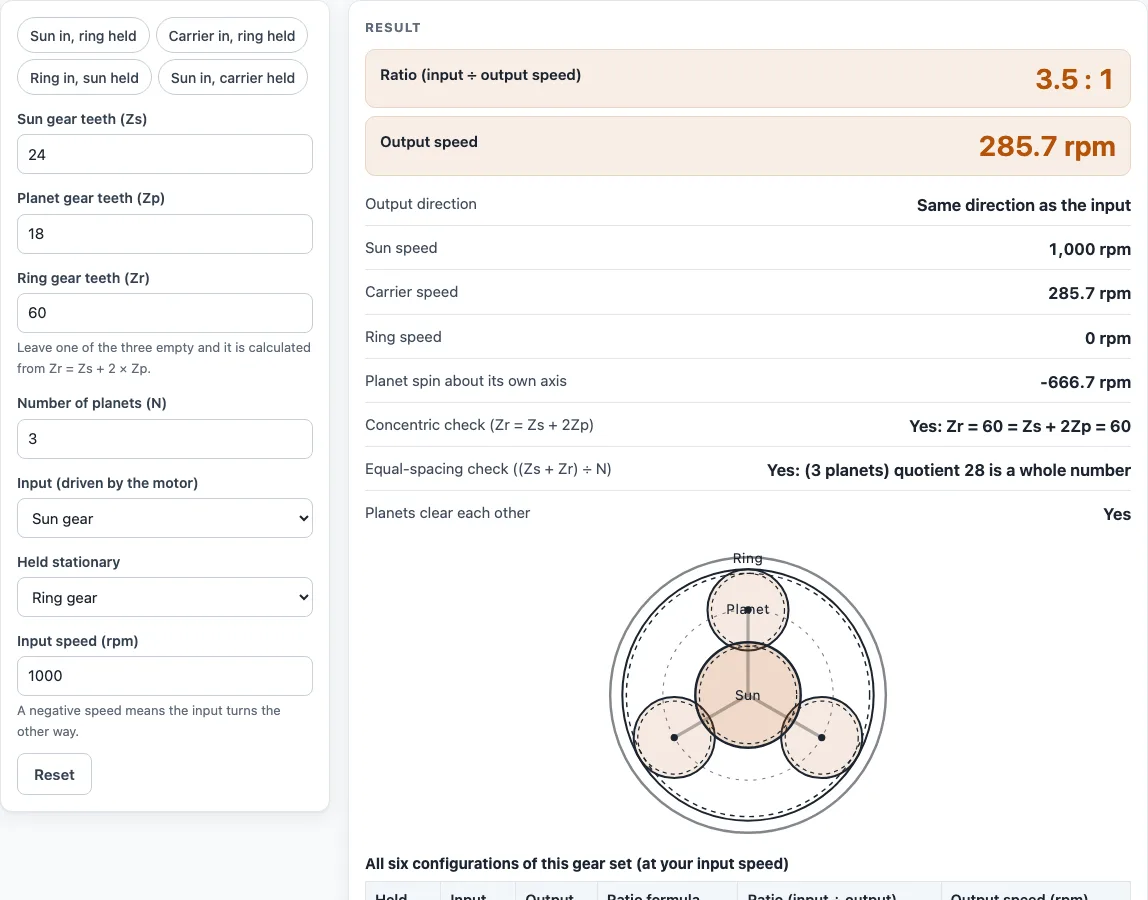
Preset buttons above the form load typical cases, and Reset restores the starting example: Zs 24, Zp 18, Zr 60, 3 planets, sun in at 1000 rpm with the ring held.
The drawing under the result shows the sun, planets and ring to scale, so a set that fails a check is easy to spot.
How is a planetary gear ratio calculated?
The ratio is found with the Willis equation: wsun × Zs + wring × Zr = wcarrier × (Zs + Zr). Set the speed of the held member to 0, solve for the output speed in terms of the input, and divide the input speed by the output speed.
What are the planetary gear ratio formulas for each configuration?
With the ring held and the sun as input, the sun-to-carrier ratio is 1 + Zr/Zs. With the sun held and the ring as input, the ring-to-carrier ratio is 1 + Zs/Zr. With the carrier held, the sun-to-ring ratio is -Zr/Zs. For Zs 24 and Zr 60, these give 3.5, 1.4 and -2.5. Applied to a 1000 rpm sun input with the ring held, the carrier turns at 1000 ÷ 3.5 = 285.7 rpm in the same direction.
What does a negative or below-1 planetary gear ratio mean?
The ratio is input speed divided by output speed. A negative value means the output turns opposite to the input, as in the carrier-held case, where the ring turns at -400 rpm from a 1000 rpm sun input. A ratio below 1 is a speed-up. With the carrier as input and the ring held, the ratio is 0.2857, so the sun turns at 3,500 rpm from a 1000 rpm carrier.
The planets also spin about their own axes. The tool uses wp = wc − (ws − wc) × Zs/Zp. For the default set, a 1000 rpm sun input with the ring held gives a planet spin of −666.7 rpm.
How do the tooth counts and planet checks work?
The concentric check requires Zr = Zs + 2 × Zp. If it fails, the speed ratio is still calculated, but a warning says the gears are not concentric with equal modules.
The equal-spacing check requires (Zs + Zr) ÷ N to be a whole number, so that all planets are evenly spaced and mesh together. The default set gives (24 + 60) ÷ 3 = 28, which passes.
The planet clearance check requires (Zs + Zp) × sin(π/N) to be greater than Zp + 2. Each failing check gives its own warning.
Worked examples
| Input | Result |
|---|---|
| Zs 24, Zp 18, Zr 60, sun in 1000 rpm, ring held | ratio 3.5 : 1, output 285.7 rpm |
| Zs 24, Zp 18, Zr 60, carrier in 1000 rpm, ring held | ratio 0.2857 : 1, output 3,500 rpm |
| Zs 24, Zp 18, Zr 60, ring in 1000 rpm, sun held | ratio 1.4 : 1, output 714.3 rpm |
| Zs 12, Zp 18, Zr 48, sun in 3000 rpm, ring held | ratio 5 : 1, output 600 rpm |
| Zs 24, Zp 18, Zr 60, sun in 1000 rpm, carrier held | ratio -2.5 : 1, output -400 rpm |
Calculated by the tool above with these values.
Frequently asked questions
Can I use the results in commercial projects or client reports?
Yes. Results may be used in commercial work, including quotes, design notes, reports and client projects, without attribution. The page states that results are for estimation, so verify critical designs against the applicable standard. The tool does not certify compliance with any code.
Is the calculator free, and is anything I type uploaded?
The calculator is free and needs no account or sign-up. Everything is calculated in your browser, and nothing you type is uploaded.
Can I print or share a calculation?
Yes. “Print / save as PDF” produces a one-page record with the inputs, results, calculation steps and date. “Copy link” copies the page address, which stores every input in the ?s= part of the URL, so the same calculation reopens later or can be sent to a colleague. “Copy result” copies the result lines with a link.
Can this calculator handle compound planetary gearboxes?
No. The page covers one simple planetary stage only and does not handle compound planetary sets. For a compound gearbox, calculate each stage separately and combine the ratios.
Why does the tool warn that the gears are not concentric?
The warning appears when Zr is not equal to Zs + 2 × Zp. The speed ratio is still calculated, because the Willis equation uses only Zs and Zr. Change the tooth counts so that the concentric check passes if the set must mesh with equal modules.
Related tools
- Bicycle Gear Calculator: use it to work out speeds and gear ratios for a bicycle drivetrain.
- Spur Gear Calculator: use it for ratios and geometry of a simple pair of spur gears.
- Gear Ratio Calculator and Gear Ratio Finder: use it to find a gear ratio from tooth counts or speeds in general.
- Axle Ratio Calculator: use it to check how a final drive ratio changes vehicle speed and engine rpm.
- Bearing Life Calculator: use it to estimate how long a bearing will last under a given load and speed.
- Belt Length Calculator: use it to find the belt length needed for a set of pulleys.
- Chain Length Calculator: use it to find the chain length needed for a set of sprockets.
- All power transmission calculators: use it to browse every calculator on the site.
Sources
Willis equation and assembly conditions: Shigley’s Mechanical Engineering Design §13-14; Norton, Design of Machinery. For estimation; verify critical designs against the applicable standard.