Gearbox Calculator
Enter the input speed, power or torque and the gearbox ratio to get the output rpm, torque and power, or find the ratio for an output speed.
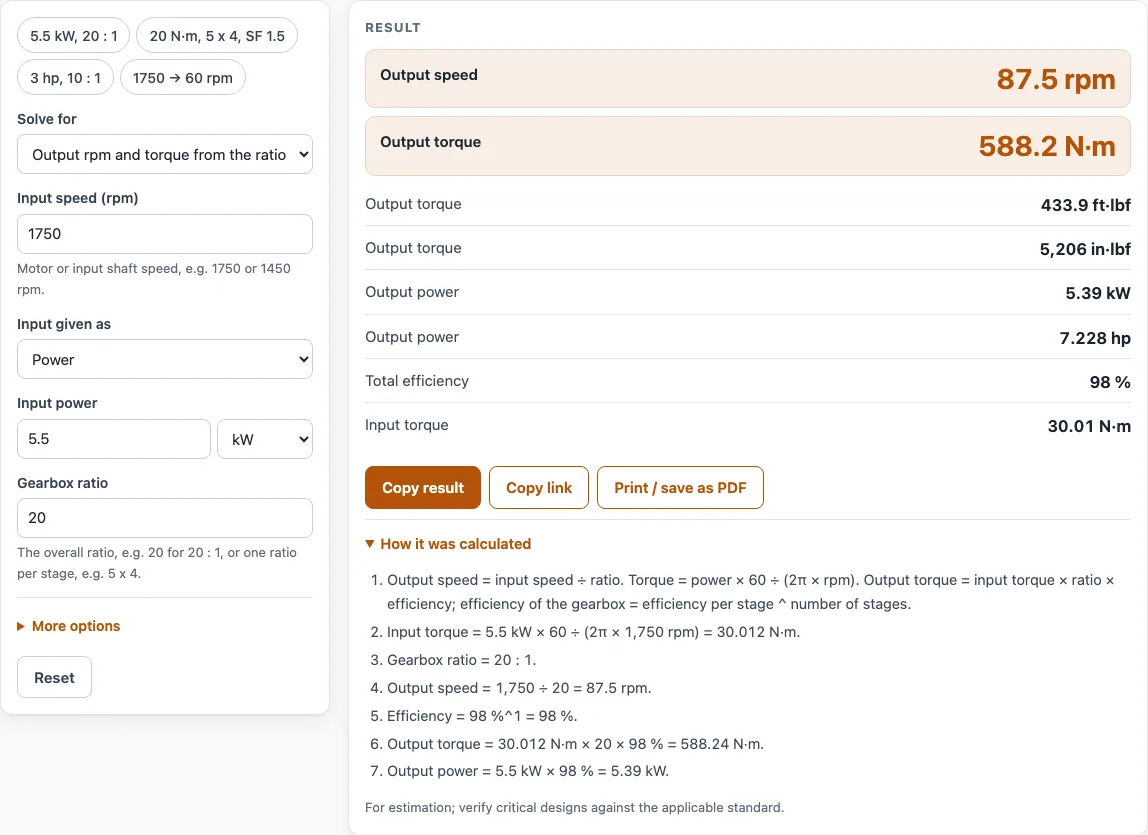
How to use the Gearbox Calculator
- Under Solve for, choose Output rpm and torque from the ratio if you know the gearbox ratio, or Ratio needed for a wanted output rpm if you need to find the ratio.
- Enter the input rpm, the speed of the motor or shaft that drives the gearbox.
- Under Input given as, choose power or torque and enter the value. Pick the unit from the menu next to the value: kW, hp or W for power, and N·m, ft·lbf or in·lbf for torque.
- Enter the ratio. Type an overall ratio such as 20 for 20 : 1, or one ratio per stage such as 5 x 4 for a two-stage gearbox.
- For the wanted-rpm mode, enter the output rpm you need instead of a ratio.
- Read the result, which updates as you type. Open How it was calculated under the result to see the formula, the values used and the answer with units.
- If you need efficiency, the number of stages or a service factor, open More options. These are optional and start at their default values.
Use the preset buttons above the form to load typical cases, and Reset to return to the starting example. Copy result copies the result lines with a link. Copy link copies the page address, which stores all your inputs so the same calculation can be reopened or sent to a colleague. Print / save as PDF creates a one-page record with the inputs, results, calculation steps and date.
How does a gearbox calculator work out output rpm and torque?
A gearbox calculator uses a few simple rules. The output speed is the input rpm divided by the ratio. A 20 : 1 gearbox turns the shaft 20 times slower, so 1750 rpm becomes 87.5 rpm.
Power and torque are linked through speed. The input torque from a power value is T = P × 60 / (2π n), which is about 9549 × kW / rpm in N·m. For 5.5 kW at 1750 rpm, that gives 30.01 N·m.
The output torque is the input torque multiplied by the ratio and the total efficiency. Output power is the input power multiplied by the total efficiency. Some energy is lost to friction in the gears, so the efficiency is always below 100 %. A typical single spur or helical stage is about 98 %, and worm gearboxes are often much lower, so check the manufacturer’s data.
The total efficiency is the efficiency per stage raised to the number of stages. Each ratio you type counts as one stage unless you set the number of stages yourself. The overall ratio for several stages is their product, so 5 x 4 gives 20 : 1. With 97 % per stage and two stages, the total efficiency is 0.97 × 0.97 ≈ 94.1 %.
A service factor, if you use one, multiplies the output torque to give the torque you should size the gearbox for. The factor itself must come from the manufacturer’s service-factor table.
How do you calculate gearbox torque from power?
For 5.5 kW at 1750 rpm through a 20 : 1 gearbox at 98 %, the input torque is 30.01 N·m, the output speed is 87.5 rpm and the output torque is 30.01 × 20 × 0.98 ≈ 588 N·m. The same works in US units with T (lbf·ft) = 5252 × hp ÷ rpm. Treat the results as estimates and check critical designs against the manufacturer’s ratings.
Worked examples
| Input | Result |
|---|---|
| 1750 rpm, 5.5 kW, 20 : 1 | 87.5 rpm, 588.2 N·m (433.9 ft·lbf) |
| 1450 rpm, 20 N·m, ratio 5 x 4 | 72.5 rpm, 376.4 N·m (277.6 ft·lbf) |
| 1750 rpm, 3 hp, 10 : 1 | 175 rpm, 117.2 N·m (86.43 ft·lbf) |
| 1750 rpm, 1.5 kW, → 60 rpm | 60 rpm, 226.8 N·m (167.3 ft·lbf) |
Calculated by the tool above with these values.
Frequently asked questions
Can I use the results in commercial projects or client reports?
Yes, including quotes, design notes, reports and client projects, without attribution.
Is the gearbox calculator free, and is anything I type uploaded?
Yes, the calculator is free to use. All calculations run in your browser, and nothing you type is uploaded. You do not need an account or sign-up.
Can I print or share a calculation?
Yes. Print / save as PDF gives you a one-page record with the inputs, results, steps and date. To share, use Copy link, which keeps all your inputs in the page address so the same calculation opens for anyone you send it to.
What does the efficiency setting change?
Efficiency reduces the output torque and output power, because some energy is lost in the gears. The default is 98 % per stage, which suits a single spur or helical stage. Lower values give more conservative results, and worm gearboxes are often well below this default.
What is a service factor?
A service factor is a multiplier that increases the output torque to allow for shock loads, long running hours or other harsh duty. The calculator multiplies the output torque by it to give a size-for torque. The value must come from the manufacturer’s service-factor table, and it must be between 1 and 4 here.
How do I find the gear ratio for a wanted output speed?
Switch to the Ratio needed for a wanted output rpm mode and enter the input rpm and the wanted output rpm. The ratio is the input rpm divided by the output rpm. For example, 1750 rpm to 60 rpm needs a ratio of 29.17 : 1.
Why does the calculator show a warning?
Warnings appear when a value looks unusual or wrong. These include efficiency below 50 %, a ratio below 1 (which is a speed-up), a single-stage ratio above 100 : 1, a service factor below 1 or above 4, and an input speed above 10,000 rpm. Efficiency above 100 % is rejected.
Related tools
- Gear Ratio Calculator and Gear Ratio Finder : use this when you need to find the ratio between two gears or sprockets.
- Axle Ratio Calculator : use this to work out the final drive ratio of a vehicle axle.
- Bearing Life Calculator : use this to estimate how long a bearing will last under a given load.
- Belt Length Calculator : use this to find the belt length needed for a set of pulleys.
- Bicycle Gear Calculator : use this to compare gear combinations on a bicycle.
- Chain Length Calculator : use this to find the number of links needed for a chain drive.
- Conveyor Belt Speed Calculator : use this to find the belt speed of a conveyor.
- All power transmission calculators : use this to browse every calculator on the site.
Sources
T = P/ω with 9549.3 = 60000/2π (N·m, kW, rpm) and 5252.1 = 33000/2π (lbf·ft, hp, rpm); Shigley’s Mechanical Engineering Design, ch. 13. For estimation; verify critical designs against the applicable standard.