Conveyor Belt Speed Calculator
Enter the drive pulley diameter and its rpm, or the motor speed and gearbox ratio, to get the belt speed, or find the rpm for a speed you need.
The conveyor belt speed calculator works out how fast a conveyor belt travels from the diameter and rotational speed of its drive pulley. It also works in reverse, giving the pulley rpm needed to reach a target belt speed. It runs entirely in your browser, is free, and needs no sign-up.
You can use it to check an existing conveyor or to size a new drive. The results appear as you type, so you can change a pulley size or gearbox ratio and see the effect straight away. Results are shown in metres per second, metres per minute and feet per minute, so you can compare them with specifications written in either unit system.
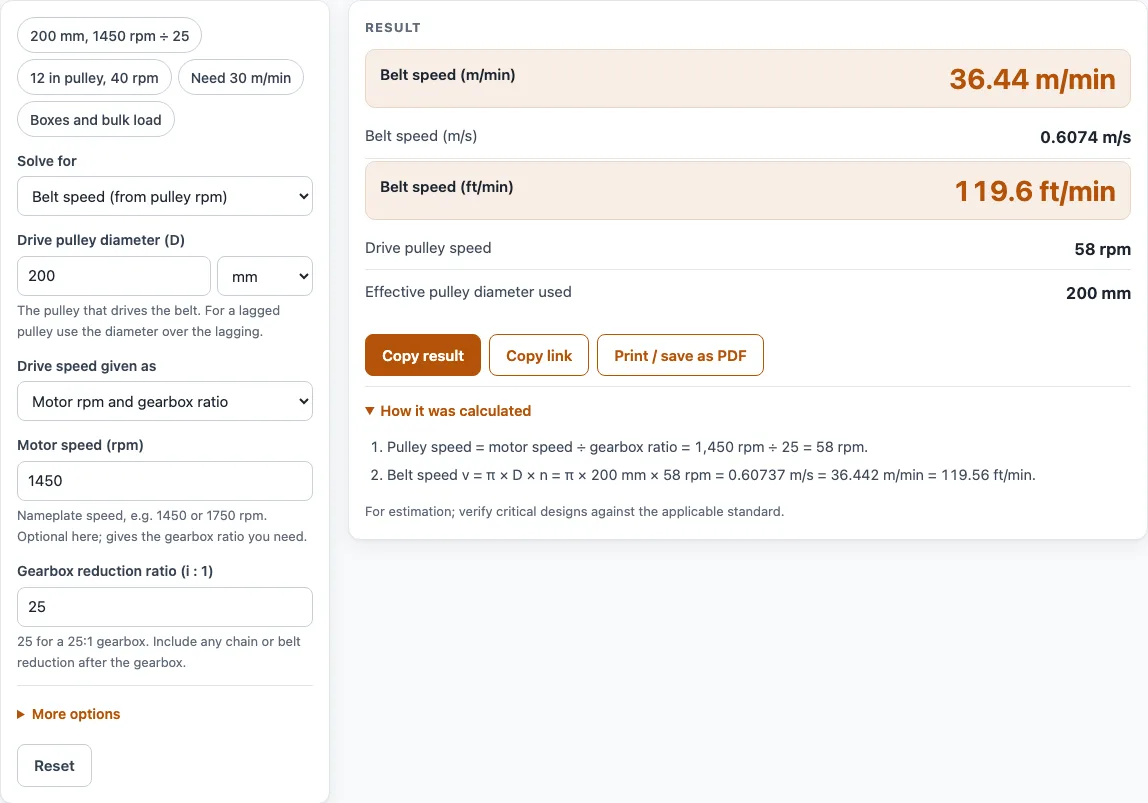
How to use the Conveyor Speed Calculator
- Under Solve for, choose belt speed from pulley rpm, or the pulley rpm needed for a target belt speed.
- In speed mode, enter the drive pulley diameter and pick its unit (mm, cm, in, m or ft).
- Enter the drive speed either as pulley rpm, or as motor rpm plus the gearbox reduction ratio.
- In required mode, enter the target belt speed and pick its unit (m/s, m/min, ft/min or ft/s). If you also enter a motor speed, the result includes the total reduction ratio.
- Read the result. It updates as you type, so check it against the value you expect.
- Open “How it was calculated” under the result to see the formula, the substituted values and the answer with units.
- If you need the optional extras, open “More options” to add belt thickness, item pitch, or load area and bulk density.
Each quantity has its own unit menu, so you can mix metric and US customary units in one calculation. Preset buttons above the form load typical cases, and “Reset” returns the form to its starting example. “Copy link” stores every input in the page address, so the same calculation can be reopened later or sent to a colleague. “Print / save as PDF” produces a one-page record with the inputs, results, calculation steps and date.
How do you calculate the speed of a conveyor belt?
The belt speed equals the pulley’s circumference multiplied by its rotational speed. The formula is v = π × D × n, where D is the drive pulley diameter and n is the pulley speed in revolutions per second. Each revolution moves the belt one circumference’s length, so multiplying by revolutions per second gives metres per second.
For example, a 200 mm pulley driven by a 1450 rpm motor through a 25:1 gearbox turns at 58 rpm. The pulley circumference is π × 0.2 m = 0.6283 m, so the belt speed is 0.6283 × 58 ÷ 60 = 0.6074 m/s, or 36.44 m/min.
What does belt thickness change in the calculation?
The belt rides on the pulley, but its driving layer sits at the belt’s neutral line, which is outside the pulley surface. The calculator adds the belt thickness t to the pulley diameter, so the effective diameter is D + t. This makes the result slightly higher than the bare-pulley figure. If you leave the thickness empty, the bare pulley diameter is used.
How do you find the pulley speed needed for a target belt speed?
Rearrange the same formula to n = v ÷ (π × D). Convert the target speed to metres per second and the diameter to metres, then divide. For a 300 mm pulley that must move the belt at 30 m/min (0.5 m/s), the pulley needs 0.5 ÷ (π × 0.3) = 0.5305 rev/s, which is 31.83 rpm. From a 1450 rpm motor, that is a total reduction of about 45.55:1.
How are item rate and bulk capacity worked out?
Items per minute equal the belt speed divided by the item pitch, which is the front-to-front spacing between items. Bulk capacity is Q = A × v × ρ, where A is the cross-sectional area of the load, v is the belt speed and ρ is the bulk density. Both the area and the density are needed for this value. The result is shown in tonnes per hour, short tons per hour and cubic metres per hour.
Worked examples
| Input | Result |
|---|---|
| D = 200 mm, 1450 rpm ÷ 25 | v = 0.6074 m/s = 36.44 m/min = 119.6 ft/min |
| D = 12 in, 40 rpm | v = 0.6384 m/s = 38.3 m/min = 125.7 ft/min |
| D = 300 mm, v = 30 m/min | n = 31.83 rpm, 45.55:1 |
| D = 160 mm, 60 rpm | v = 0.5278 m/s = 31.67 m/min = 103.9 ft/min |
Calculated by the tool above with these values.
Frequently asked questions
Can I use the results in commercial projects or client reports?
Yes. You may use the results in commercial work, including quotes, design notes, reports and client projects, without giving attribution. The page notes that results are for estimation, so verify critical designs against the applicable standard.
Is the calculator free, and is anything I type uploaded?
The calculator is free and needs no account or sign-up. Everything is calculated in your browser, and nothing you type is uploaded.
Can I print or share a calculation?
Yes. “Print / save as PDF” creates a one-page record with the inputs, results, calculation steps and date. “Copy link” copies a page address that stores your inputs, and “Copy result” copies the result lines with a link.
What does the warning about belt speed above 10 m/s mean?
The calculator shows this warning when the belt speed is above 10 m/s, which is outside normal belt conveyor practice. Check the input values, because a speed this high is unusual for a standard belt conveyor.
Can I use feet and inches?
Yes. Enter the pulley diameter in inches or feet and read the speed in ft/min or ft/s; the 12 in pulley preset shows a US example.
Related tools
- Gear Ratio Calculator - use it to work out the reduction ratio when your gearbox or pulley setup needs checking.
- Axle Ratio Calculator - use it to find the ratio and speed relationship for an axle drive.
- Bearing Life Calculator - use it to estimate how long a bearing in your drive will last.
- Belt Length Calculator - use it to find the belt length needed for a given pulley layout.
- Bicycle Gear Calculator - use it to compare chainring and sprocket combinations and the speeds they give.
- Chain Length Calculator - use it to find the chain length for a sprocket pair and centre distance.
- Gearbox Calculator - use it to work through gearbox ratios and output speeds.
- All power transmission calculators - use it to browse every calculator on the site.
Sources
v = π·D·n/60 (textbook kinematics); bulk capacity Q = A·v·ρ as in CEMA, Belt Conveyors for Bulk Materials; short ton 907.18474 kg (NIST SP 811). For estimation; verify critical designs against the applicable standard.