Chain Length Calculator
Enter the sprocket teeth, chain pitch and centre distance to get the number of links, or use the bicycle mode for a derailleur chain.
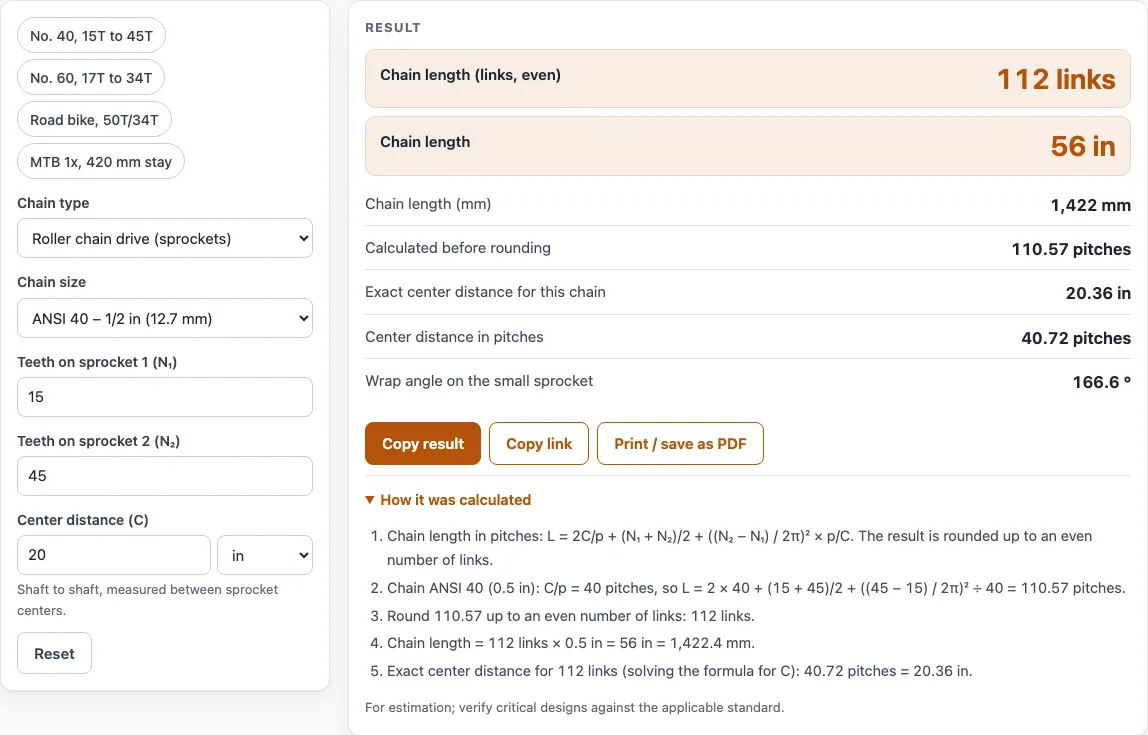
How to use the chain length calculator
- Under Chain type, choose the roller chain drive between two sprockets, or the bicycle chain sized from the chainstay.
- For a roller chain, pick the chain size from the menu. Options run from ANSI 25 to 120 or ISO 06B to 16B.
- Enter the number of teeth on each sprocket.
- Enter the center distance and choose its unit: in, mm, cm, ft or m.
- For a bicycle, enter the chainstay length, the teeth on the largest chainring (F) and the teeth on the largest rear cog (R).
- Read the result. The link count is always even, and the length is shown in inches and millimetres.
- Check any warnings below the result.
- Open How it was calculated to see the formula, the values substituted and the answer with units.
Preset buttons above the form load typical cases, such as No. 40 with 15T to 45T, a road bike or a mountain bike 1x. Less common inputs sit under More options, and Reset restores the starting example. The result panel also has Copy result, Copy link and Print / save as PDF buttons.
For example, the No. 40 preset (15 and 45 teeth) gives the even link count and the exact centre distance for that chain, so you can see how far the sprockets must move.
How do you calculate roller chain length?
The roller chain figure comes from the standard formula L = 2C/p + (N1 + N2)/2 + ((N2 − N1)/(2π))² × p/C, where C and p use the same unit. The tool rounds the result up to the next even number of links, because an odd count would need an offset link. It then solves the same formula for the exact center distance of that chain, which shows how far the fixed link count moves the sprockets.
The wrap angle on the small sprocket is 180° − 2 × asin((PD2 − PD1)/(2C)), where each pitch diameter is PD = p / sin(180°/N). The tool warns when this angle falls below 120 degrees. For a bicycle, the estimate is 2 × chainstay + F/4 + R/4 + 1 inches, and since each bicycle chain link is 1/2 inch, the link count is twice that length, rounded up to an even number.
How can I check or share a chain calculation?
Print / save as PDF produces a one-page record with the inputs, results, calculation steps and date, which suits a design file or a quote. Copy link stores every input in the ?s= part of the page address, so the same calculation reopens later or can be sent to a colleague. The “How it was calculated” panel lists each substituted value, so a reviewer can follow every step. Each quantity has its own unit menu, so a single calculation can mix metric and US customary units, and the tool converts them before calculating.
Worked examples
| Input | Result |
|---|---|
| ANSI 40, 15 and 45 teeth, center distance 20 in | 112 links (56 in), exact center distance 20.36 in |
| ANSI 60, 17 and 34 teeth, center distance 600 mm | 90 links (67.5 in), exact center distance 612.19 mm |
| ISO 08B, 21 and 21 teeth, center distance 40 cm | 84 links (42 in), exact center distance 40.005 cm |
| chainstay 420 mm, 50T largest chainring, 34T largest cog | 112 links (56 in) |
| chainstay 17 in, 36T largest chainring, 50T largest cog | 114 links (57 in) |
Calculated by the tool above with these values.
Frequently asked questions
Can I use the results in commercial projects or client reports?
Yes, in quotes, design notes, reports and client projects, without attribution. Results are estimates, so check safety-critical drives against the governing standard.
Is the chain length calculator free, and is anything I type uploaded?
Yes, the calculator is free and needs no account or sign-up. All calculations run in your browser, and nothing you type is uploaded.
What chain sizes and tooth counts can I enter?
Roller chain sizes run from ANSI 25 to 120 or ISO 06B to 16B. The tool warns you when a sprocket has under 9 teeth.
Why is the result rounded up to an even number of links?
An odd number of links would need an offset link, so the tool rounds up to the next even count. The chain ends up slightly longer than the raw figure, and the exact center distance shows the effect.
What does the warning about large slack mean?
Rounding up can leave the chain noticeably looser than the raw length. Compare the length before rounding with the chain you plan to install, and check that the sprockets can be moved to take up the slack.
Why should I check a bicycle result on the bike?
The bicycle formula is a starting estimate. Full-suspension frames may need extra links, so fit the chain and check it at the largest chainring and cog before you cut it to length.
What do the sprocket and center distance warnings cover?
The tool warns when the center distance is under 30 or over 80 pitches, when the sprockets would touch, or when the center distance is below the larger sprocket’s outside diameter. Bicycle inputs also warn when the chainstay is outside 10 to 24 in, the chainring is outside 20 to 70 teeth, or the cog is outside 9 to 52 teeth.
Related tools
- Belt Length Calculator: use it when your drive uses a belt instead of a roller chain.
- Gear Ratio Calculator and Gear Ratio Finder: use it to compare the speed ratio of two gears or sprockets.
- Axle Ratio Calculator: use it to work out the final drive ratio in a vehicle axle.
- Bearing Life Calculator: use it to estimate how long a bearing will last under a given load.
- Bicycle Gear Calculator: use it to see the gear inches and speeds for a bicycle’s chainring and cog combinations.
- Conveyor Belt Speed Calculator: use it to find the linear speed of a conveyor from its drive pulley.
- Gearbox Calculator: use it to work out the ratios and output speeds of a multi-stage gearbox.
- All power transmission calculators: use it to browse every calculator on the site.
Sources
Roller chain length formula: Machinery’s Handbook and maker catalogues; pitches per ASME B29.1 and ISO 606; bicycle formula 2C + F/4 + R/4 + 1 as published by Omni Calculator. For estimation; verify critical designs against the applicable standard.