Belt Length Calculator
Enter both pulley diameters and the centre distance to get the belt length, or a belt length to get the centre distance, with wrap angle and speed ratio.
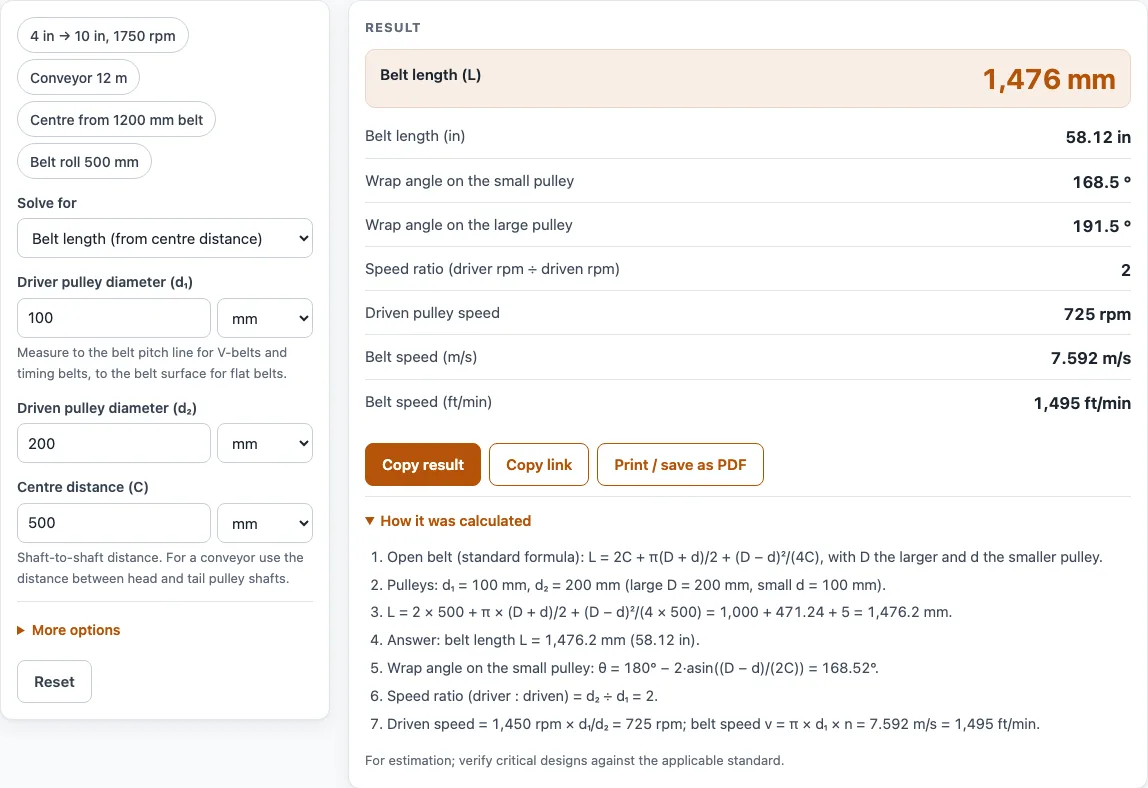
How to use the Belt Length Calculator
- Under “Solve for”, choose a mode: belt length from centre distance, centre distance from a known belt length, or the length of a belt wound on a roll.
- For the two-pulley modes, enter the driver pulley diameter d1 and the driven pulley diameter d2. Pick a unit for each (mm, cm, in, m or ft). The pulleys can be entered in either order.
- Enter either the centre distance C or the belt length L, depending on the mode, and pick its unit.
- For a roll, enter the outer diameter D, the core diameter d and the belt thickness t.
- Optional: open “More options” to enter the driver speed in rpm, choose an open or crossed belt layout, and choose the standard or exact formula.
- Read the result under the form. Open “How it was calculated” to see the formula, the values substituted and the answer with units. Check any warning message before you use the figure.
Preset buttons above the form load typical cases, and “Reset” restores the starting example. “Copy result” copies the result lines with a link. “Copy link” copies the page address, which stores every input, so the same calculation reopens later. “Print / save as PDF” produces a one-page record with the inputs, results, steps and date.
What is the belt formula length?
For an open belt over two pulleys, the standard approximation is L = 2C + π(D + d)/2 + (D − d)²/(4C). Here D is the larger pulley diameter, d is the smaller, and C is the centre distance. For a crossed belt, the last term becomes (D + d)²/(4C).
The exact formula is L = 2C cos φ + π(D + d)/2 + φ(D − d), where sin φ = (D − d)/(2C). For a crossed belt, D − d is replaced by D + d. For example, with d1 = 100 mm, d2 = 200 mm and C = 500 mm, the standard formula gives L = 1476.2 mm and the exact formula gives 1476.24 mm. The calculator warns you if the two differ by more than 0.5 percent.
The formula can also be turned round. For a known length, b = 4L − 2π(D + d) and C = (b + √(b² − 32(D − d)²))/16. The wrap angle on the small pulley of an open belt is 180° − 2 asin((D − d)/(2C)). A wrap below 120° triggers a warning. A belt on a roll has length L = π(D² − d²)/(4t), with (D − d)/(2t) layers.
The speed ratio is d2/d1. If you enter a driver speed, the driven speed is rpm × d1/d2, and the belt speed is v = π × d1 × n/60.
Is the calculated belt length the belt size to buy?
Not directly. The result is the geometric length for your pulleys, and the tool does not look up standard belt sizes. For a critical design, check the final length against the belt maker’s data. Also check that the centre distance fits your frame or adjustment range, because a belt length found by the formula does not account for that.
Worked examples
| Input | Result |
|---|---|
| d₁ = 100 mm, d₂ = 200 mm, C = 500 mm | L = 1,476 mm |
| d₁ = 4 in, d₂ = 10 in, C = 24 in | L = 70.37 in |
| d₁ = 60 mm, d₂ = 180 mm, L = 1200 mm | C = 407.1 mm |
| d₁ = 300 mm, d₂ = 300 mm, C = 12 m | L = 24.94 m |
| D = 500 mm, d = 150 mm, t = 2 mm | L = 89.34 m (293.1 ft) |
Calculated by the tool above with these values.
Frequently asked questions
Can I use the results in commercial projects or client reports?
Yes. Results may be used in commercial work, including quotes, design notes, reports and client projects, without attribution. They are estimates; verify critical designs against the applicable standard.
Is the calculator free, and is anything I type uploaded?
Yes, the calculator is free. Everything is calculated in your browser, nothing you type is uploaded, and there is no account or sign-up.
Can I print or share a calculation?
Yes. “Print / save as PDF” produces a one-page record with the inputs, results, calculation steps and date. “Copy link” stores all inputs in the page address, so you can send it to a colleague or reopen it later.
Can I mix metric and US units?
Yes. Each quantity has its own unit menu, so you can enter one pulley in mm and the other in inches. The tool converts the units before calculating.
What do the warning messages mean?
Warnings flag results that need a closer look. They appear when the centre distance is above 3(D + d) or smaller than the large pulley, when an open-belt wrap on the small pulley is below 120°, when the standard and exact formulas differ by more than 0.5 percent, when belt speed is above 30 m/s, and for crossed belts, which cause twist and wear.
Why did I get an error message?
The centre distance must be greater than the sum of the two pulley radii, otherwise the pulleys would overlap. A belt length shorter than the shortest possible belt for those pulleys is rejected. For a roll, the outer diameter must be greater than the core diameter.
Will the calculator tell me which standard belt to buy?
No. It calculates the length from your dimensions but does not match them to standard sizes. For that, use the V Belt Calculator or the Timing Belt Calculator, and confirm with the supplier.
Related tools
- Chain Length Calculator: use it when the drive uses a chain and sprockets instead of a belt.
- Timing Belt Calculator: use it for toothed belts that need a standard tooth profile and pitch.
- V Belt Calculator: use it to check V-belt sizes and lengths against standard profiles.
- Gear Ratio Calculator: use it to find the speed ratio when a gear train is used instead of a belt drive.
- Bicycle Gear Calculator: use it to compare gear combinations on a bicycle drivetrain.
- All power transmission calculators: use it to browse every calculator on the site in one list.
Sources
Shigley’s Mechanical Engineering Design (open and crossed belt length, wrap angle); Machinery’s Handbook, belt-drive geometry. For estimation; verify critical designs against the applicable standard.