Bearing Life Calculator
Enter the dynamic load rating, the bearing load and the speed to get the L10 rating life in hours, or the load rating needed for a target life.
How to use the bearing life calculator
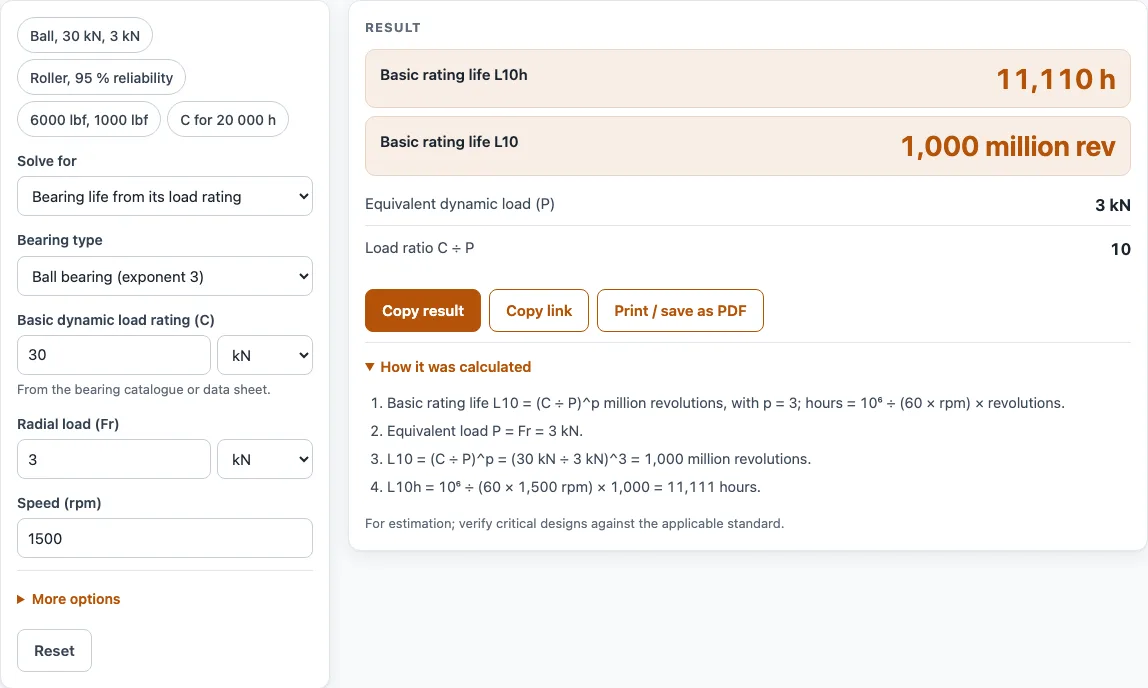
- Under Solve for, choose a mode. Use “Bearing life from its load rating” to find the life of a bearing you already have, or “Load rating (C) needed for a target life” to find the rating you need. You can also click a preset button to load a typical case.
- In the first mode, enter the basic dynamic load rating C and pick its unit (kN, N or lbf) from its unit menu.
- Enter the radial load Fr and pick its unit. The units can differ from C’s, because the tool converts them before calculating.
- Enter the speed in rpm and select the bearing type, ball or roller.
- Read the result. It updates as you type and shows L10 in million revolutions and L10h in hours. Open “How it was calculated” to see the formula, the values substituted and the answer with units.
- If the load has a thrust component, open “More options” to enter X, Y and the axial load Fa from the bearing maker’s data. The same panel holds reliability (default 90 %) and aISO (default 1).
- Select Reset at any time to return to the starting example.
Use “Copy result” to copy the result lines with a link, or “Print / save as PDF” to produce a one-page record. “Copy link” copies the page address, which stores every input in the ?s= part of the URL, so the same calculation reopens later or can be sent to a colleague.
What is the bearing life equation?
The bearing life equation is L10 = (C / P)^p, where L10 is the basic rating life in millions of revolutions, C is the basic dynamic load rating, and P is the equivalent dynamic load. The exponent p is 3 for ball bearings and 10/3 for roller bearings. L10 is the number of revolutions that 90 % of a group of identical bearings reach under the same load.
To convert revolutions to hours, use L10h = 10^6 / (60 n) × L10, where n is the speed in rpm. At 1500 rpm, one million revolutions takes about 11.1 hours.
How is the equivalent load P found?
P is found from P = X × Fr + Y × Fa, and it is the single load that gives the same life as the real combined load. By default X = 1 and Y = 0, so P equals the radial load Fr. For combined loads, X and Y come from the bearing maker’s data, because the tool does not contain manufacturer tables. If you enter an axial load while Y is 0, the axial load is ignored and a warning appears.
How does reliability change bearing life?
A reliability above 90 % shortens the calculated life. The modified life is Lnm = a1 × aISO × L10, where a1 is the ISO 281:2007 factor: 95 % gives 0.64, 96 % gives 0.55, 97 % gives 0.47, 98 % gives 0.37 and 99 % gives 0.25. The aISO factor comes from the maker’s own calculation and accounts for lubrication, contamination and temperature. For example, a roller bearing with L10 of 2,154 million revolutions (23,940 hours) has a life of 15,320 hours at 95 % reliability.
How do you find the load rating needed for a target life?
Rearrange the equation to C = P × L10^(1/p). First convert the target life into the required L10 with (hours × 60 × rpm / 10^6) / (a1 × aISO). For 20,000 hours at 1500 rpm with P = 3 kN and 90 % reliability, the required L10 is 1,800 million revolutions. A ball bearing then needs C of at least 36.49 kN and a roller bearing needs at least 28.43 kN. At 95 % reliability, a ball bearing needs 42.35 kN.
Worked examples
| Input | Result |
|---|---|
| ball bearing, C 30 kN, P 3 kN, 1500 rpm | L10 1,000 million rev = 11,110 h |
| roller bearing, C 30 kN, P 3 kN, 1500 rpm | L10 2,154 million rev = 23,940 h; at 95 % reliability 15,320 h |
| ball bearing, C 6000 lbf, P 1,000 lbf, 1000 rpm | L10 216 million rev = 3,600 h |
| ball bearing, C 30 kN, P 2.72 kN, 1500 rpm | L10 1,342 million rev = 14,910 h |
| ball bearing, P 3 kN, 1500 rpm, 20000 h, 90 % | C ≥ 36.49 kN |
Calculated by the tool above with these values.
Frequently asked questions
Can I use the results in commercial projects or client reports?
Yes. Results may be used in commercial work, such as quotes, design notes, reports and client projects, without attribution. The tool gives estimates and does not certify compliance with any code.
Is the calculator free, and is anything I type uploaded?
Yes, the calculator is free. Everything is calculated in your browser, nothing you type is uploaded, and there is no account or sign-up.
Can I print or share a calculation?
Yes. “Print / save as PDF” produces a one-page record with the inputs, results, calculation steps and date. “Copy link” lets you send the exact calculation to someone else.
Does this replace the bearing maker’s data?
No. The result is the basic rating life, and critical designs should be checked against the manufacturer’s data and the applicable standard.
Why is the life in hours so different from the life in revolutions?
Hours depend on speed: L10h = 10⁶ ÷ (60 × rpm) × L10. The same bearing and load last twice as many hours at half the speed, because it takes twice as long to reach the same number of revolutions.
Can I enter loads in pounds?
Yes. The load rating and the loads each have a unit menu with N, kN and lbf, and you can mix them; the 6000 lbf preset shows a US example.
Related tools
- Gear Ratio Calculator - use it to find the ratio between two gears before sizing the shafts and bearings.
- Axle Ratio Calculator - use it to work out the final drive ratio for a vehicle axle.
- Belt Length Calculator - use it to find the belt length needed for a pulley pair.
- Bicycle Gear Calculator - use it to compare gear combinations and speeds on a bicycle.
- Chain Length Calculator - use it to find the number of links for a chain drive.
- Conveyor Belt Speed Calculator - use it to find belt speed from pulley size and rotation speed.
- Gearbox Calculator - use it to check the ratios and output speed of a multi-stage gearbox.
- All power transmission calculators - use it to browse every calculator on the site.
Sources
ISO 281:2007 basic and modified rating life as published by SKF and NSK (a1 = 0.64, 0.55, 0.47, 0.37, 0.25 for 95 to 99 % reliability). For estimation; verify critical designs against the applicable standard.